Thursday, August 2, 2018

1 billion iPhone Xs: What Apple can buy with $1…

You know what is cooler than being worth $1 billion? Being worth $1 trillion.�

With Apple crossing a historic milestone to become the first U.S. company in history to be worth $1 trillion, we decided to take a look at some of the most outlandish things�Apple could buy with all of that money. From iPhones to Disney, unsurprisingly the answer is quite a lot.�

More than�1 billion iPhone Xs

There are roughly 7.5 billion people in the world, so what better way to say thank you than to buy 1 billion of them new iPhone Xs. While not enough to give everyone in China or India a new phone, at a starting price of $999.99 for the 64GB model�Apple can still gift nearly 13 percent�percent of the world's population with its latest iPhone (or latest model for now).

 (Photo: Apple)

Apple would rank No. 17 if it was the GDP of a country

Apple's $1 trillion market cap is larger than the gross domestic product of all but 16 countries based on data from the International Monetary Fund. Slotting in at the 17th spot behind Indonesia ($1.07 trillion), Apple would be larger than the GDPs of the Netherlands, Turkey, Saudi Arabia, Switzerland and Argentina.�

Its valuation is also more than the GDPs of Ireland, Israel and Greece �� combined.

A man sells greek flags during a protest against Greece's new name deal with Macedonia in Athens, on July 1, 2018. Greece and Macedonia signed a historic preliminary agreement to rename the small Balkan nation the Republic of North Macedonia, ending a row that has poisoned relations between the two neighbours since 1991. (Photo: LOUISA GOULIAMAKI, AFP/Getty Images)

.oembed-frame { width: 100%; height: 100%; margin: 0; border: 0; }

Take out Samsung

Apple's biggest smartphone rival has been Samsung and its Galaxy S and Note line of smartphones. While Apple doesn't have enough money to buy Android-maker Google, the company could�purchase Samsung, which is worth $326.44 trillion South Korean Won, or about $289.4 billion in U.S. currency.

Apple not only would benefit from owning the�Samsung maker, but also get the South Korean giant's impressive manufacturing capabilities, which Apple already uses to make some parts for its own products.

A man walks past a display for Samsung Galaxy S9 smartphones at the company's showroom in Seoul on July 31, 2018. Samsung Electronics on July 31 reported a 0.1 percent dip in its second quarter net profit from a year earlier, blaming slower global sales of premium smartphones that dented demand for its flagship Galaxy device. (Photo: JUNG YEON-JE, AFP/Getty Images)

Buy Disney, Netflix and AT&T

Apple has been making moves to build out its streaming content portfolio, but why not take a shortcut and pick up three of the biggest content makers in the world? With $1 trillion, Apple can go out and buy The Walt Disney Co. (market cap of $168.16 billion), Netflix ($146.94) and AT&T, which recently purchased HBO-owner Time Warner ($234.48), and still have roughly $450 billion left over.�

Who wouldn't subscribe to a streaming service that has "The Avengers," "Star Wars," "Stranger Things" and "Game of Thrones"?

The Marvel superheroes of "Avengers: Infinity War" will be getting new folks to meet with Disney's purchase of Fox. (Photo: CHUCK ZLOTNICK)

All the teams on the Forbes�top 50 most valuable list

Why stop at media? With a trillion dollars Apple can amass the greatest fantasy sports roster every by acquiring every team on Forbes'�top 50 most valuable sports teams list. This includes 29 NFL teams led by the Dallas Cowboys ($4.8 billion); international soccer powerhouses Manchester United ($4.123 billion), Real Madrid ($4.09 billion) and Barcelona ($4.064 billion); as well as the most valuable MLB and NBA teams:�the New York Yankees ($4 billion) and New York Knicks ($3.6 billion).

The total for the lot: $137 billion.�

Kirby Lee-USA TODAY Sports

Get into cars with Tesla ... and Ford�

There have been rumors for years of Apple working on a car, but as with streaming video, why not just buy your�way into the market? For Apple, it wouldn't even cost that much. Tesla, a company that gets equated to Apple both for its products and its passionate legion of followers, is worth $55.63 billion, a relative bargain.�

Want to add more manufacturing muscle?�Apple can also kick the tires on Ford, which at a market cap of $39.4 billion would give Apple two major automakers for less than $100 billion.�

 (Photo: Tesla)

More: Apple's worth $1 trillion. What $1 trillion looks like in iPhones

More: Apple can thank iPhone a trillion times, but has Amazon to worry about

More: Apple makes history by becoming first U.S. company to reach $1 trillion market value

Follow Eli Blumenthal on Twitter @eliblumenthal

��

Sunday, July 22, 2018

Experimental treatment uses modified stem cells to fight cancer

A clinical trial run by UCLA is testing a potentially pioneering form of immunotherapy that could turn a patient's own body into a powerful weapon against cancer.

Researchers at the university's Jonsson Comprehensive Cancer Center are reinforcing the immune system's foundation by genetically modifying bone marrow stem cells, the cellular factories that power immune responses. By arming those cells with receptors that recognize cancer, researchers hope a patient's body will cure itself from the inside out.

Dr. Antoni Ribas, who is leading the trial, started working on cancer immunotherapy -- treatments that alter a patient's immune response to fend off cancer -- more than 20 years ago. He played a key role in the clinical development of Keytruda, Merck's popular immunotherapy drug used to treat several types of cancer including some types of melanoma (a type of skin cancer), Hodgkin's disease, some head and neck cancers, some non-small cell lung cancers, and some colorectal cancers. Now he's turning his attention to another therapy he finds especially exciting.

The immune system defends the body against sickness. T-cells play an integral role. They're a type of white blood cell that seeks out and destroys diseased cells. The trouble is, T-cells don't recognize cancerous cells as an adversary, leaving the body vulnerable.

Researchers already know how to get around that by extracting T-cells and adding the genetic code for receptors that detect cancer. The problem? Eventually those super-powered T-cells stop working. "We realized the immune system cells that we give back have a limited life span," Ribas said.

That's where the UCLA trial comes in.

Bone marrow stem cells are the factories that produce new T-cells. But rather than simply genetically modifying T-cells, Ribas is modifying the bone marrow stem cells that make them. In other words, he's modifying the car factory, not just the car.

The result, in theory, is a lifetime supply of cancer-fighting T-cells and, hopefully, a more cancer-resistant immune system. Testing that theory will require years of clinical trials. Daniel Apodaca, 25-year-old UCLA student who has epithelioid sarcoma, a rare, soft tissue cancer that grows slowly, became the trial's first patient in April.

Mission Ahead Cancer 1 Daniel Apodaca is a 25-year-old UCLA film student and the first patient in a clinical trial that's testing an experimental cancer immunotherapy.

"I didn't have any options before," Apodaca told CNNMoney. "So just having an option in general, I feel really lucky."

Ribas said doctors extracted some of Apodaca's bone marrow stem cells along with a batch of T-cells and modified them in the lab. Chemotherapy helped eradicate his existing immune system cells, making room for the new and improved ones. The immune system reboot kept Apodaca in a sterile hospital environment for three weeks. When he left on April 24th with his reprogrammed immune system, doctors called it his second birthday. But it will be years before they can definitively say the treatment worked.

Beyond the uncertainty inherent in any experimental treatment, immunotherapies come with risks and side effects, such as colitis, or colon inflammation, infection, or even a severe or fatal allergic reaction, although that's rare. And cell therapy carries the possibility that the upgraded immune system could attack healthy tissues, said Fred Ramsdell, Vice President of Research at the Parker Institute for Cancer Immunotherapy.

"As we try to amp up the immune system, we do run the risk of having the immune system recognize some of our normal tissues," and attack them, he said.

If that happens, "we'll pull the safety mechanism," Ribas said. "We [insert] a gene that allows us to kill them if they become bad."

mission ahead cancer 4 ribas Dr. Antoni Ribas has been working in the field of cancer immunotherapy for over 20 years.

Despite the risk, the therapy could advance the field of immunotherapy, Ramsdell said. "We need to find ways to sustain the effect of adapted cell therapies," he said. "This trial is pushing the envelope."

Achieving that progress took more than a decade of research and millions of dollars, Ribas said. The California Institute for Regenerative Medicine, a taxpayer-funded research organization, financed the trial with a $20 million grant.

Ribas estimates the therapy could cost hundreds of thousands of dollars per patient. And even if it works, big questions remain about its wider application. The key to an effective targeted immunotherapy is detecting the unique signature of a patient's specific cancer and matching it with a receptor that doctors can add to a T-cell. That's how the modified T-cell knows to attack the cancerous cells, not healthy cells. But the process of matching cancer signatures and receptors has proven difficult, and the list of matches remains relatively short.

"Our first attempt is targeting in particular two cancers, sarcomas and melanomas, because they have a protein called NY-ESO-1 that can be efficiently targeted with a receptor that we have," Ribas said. "Potentially, we could do more, but every time we use a new receptor we would have to go back to the beginning."

For now, Apodaca is responding well enough to visit his girlfriend who is finishing up school in Spain. And he manages to stay optimistic about the future. "Hopefully I become the golden child for this amazing scientific movement," he said. "I look to see some real progress in medicine and for oncology, potentially for all subtypes of cancer."

That movement remains a long way off. The therapy faces several more clinical trials and rigorous FDA review before it enters widespread use. That is, if it works. And that's a big if. But such is the nature of medical research. "That's where we push the limits of science," Ribas said. "If we don't do things like this, then we don't advance."

Saturday, July 21, 2018

Fox Run Management L.L.C. Invests $588,000 in Edwards Lifesciences Corp (EW) Stock

Fox Run Management L.L.C. bought a new stake in Edwards Lifesciences Corp (NYSE:EW) in the 2nd quarter, according to the company in its most recent Form 13F filing with the Securities and Exchange Commission. The fund bought 4,039 shares of the medical research company’s stock, valued at approximately $588,000.

A number of other hedge funds have also recently made changes to their positions in the stock. Wendell David Associates Inc. raised its stake in Edwards Lifesciences by 4.0% in the 2nd quarter. Wendell David Associates Inc. now owns 9,548 shares of the medical research company’s stock valued at $1,390,000 after purchasing an additional 363 shares during the last quarter. IHT Wealth Management LLC grew its holdings in Edwards Lifesciences by 84.6% in the 1st quarter. IHT Wealth Management LLC now owns 932 shares of the medical research company’s stock valued at $126,000 after buying an additional 427 shares during the period. Gulf International Bank UK Ltd grew its holdings in Edwards Lifesciences by 0.7% in the 1st quarter. Gulf International Bank UK Ltd now owns 66,330 shares of the medical research company’s stock valued at $9,254,000 after buying an additional 450 shares during the period. Daiwa Securities Group Inc. grew its holdings in Edwards Lifesciences by 9.1% in the 1st quarter. Daiwa Securities Group Inc. now owns 6,891 shares of the medical research company’s stock valued at $961,000 after buying an additional 572 shares during the period. Finally, WealthPLAN Partners LLC grew its holdings in Edwards Lifesciences by 22.2% in the 1st quarter. WealthPLAN Partners LLC now owns 3,225 shares of the medical research company’s stock valued at $450,000 after buying an additional 585 shares during the period. 81.27% of the stock is owned by hedge funds and other institutional investors.

Get Edwards Lifesciences alerts:

Several analysts have commented on EW shares. Zacks Investment Research upgraded Edwards Lifesciences from a “hold” rating to a “buy” rating and set a $165.00 price target for the company in a report on Saturday, July 14th. ValuEngine upgraded Edwards Lifesciences from a “hold” rating to a “buy” rating in a report on Tuesday, June 12th. SunTrust Banks restated a “buy” rating and issued a $180.00 price target on shares of Edwards Lifesciences in a report on Tuesday, April 10th. Sanford C. Bernstein started coverage on Edwards Lifesciences in a report on Wednesday, June 27th. They issued a “market perform” rating and a $165.00 price target for the company. Finally, Northland Securities cut Edwards Lifesciences from an “outperform” rating to a “market perform” rating in a report on Wednesday, April 25th. Six analysts have rated the stock with a hold rating and sixteen have assigned a buy rating to the stock. The company has an average rating of “Buy” and a consensus target price of $152.65.

In other Edwards Lifesciences news, CFO Scott B. Ullem sold 25,000 shares of the company’s stock in a transaction that occurred on Wednesday, May 9th. The stock was sold at an average price of $134.73, for a total value of $3,368,250.00. Following the completion of the transaction, the chief financial officer now owns 35,968 shares in the company, valued at approximately $4,845,968.64. The transaction was disclosed in a document filed with the SEC, which can be accessed through this hyperlink. Also, CEO Michael A. Mussallem sold 32,800 shares of the company’s stock in a transaction that occurred on Monday, April 30th. The stock was sold at an average price of $128.46, for a total value of $4,213,488.00. Following the completion of the transaction, the chief executive officer now owns 74,131 shares of the company’s stock, valued at approximately $9,522,868.26. The disclosure for this sale can be found here. Insiders have sold a total of 230,249 shares of company stock valued at $31,802,645 in the last quarter. Company insiders own 1.84% of the company’s stock.

Shares of NYSE:EW opened at $152.62 on Friday. The company has a debt-to-equity ratio of 0.14, a current ratio of 2.07 and a quick ratio of 1.63. Edwards Lifesciences Corp has a 1 year low of $100.20 and a 1 year high of $155.22. The stock has a market cap of $31.68 billion, a PE ratio of 36.83, a PEG ratio of 2.20 and a beta of 0.64.

Edwards Lifesciences (NYSE:EW) last issued its earnings results on Tuesday, April 24th. The medical research company reported $1.22 earnings per share (EPS) for the quarter, topping the Zacks’ consensus estimate of $1.11 by $0.11. Edwards Lifesciences had a return on equity of 28.60% and a net margin of 17.36%. The business had revenue of $938.00 million during the quarter, compared to analysts’ expectations of $936.69 million. During the same quarter in the previous year, the business earned $0.94 EPS. The company’s revenue for the quarter was up 6.2% on a year-over-year basis. sell-side analysts forecast that Edwards Lifesciences Corp will post 4.63 EPS for the current year.

Edwards Lifesciences Profile

Edwards Lifesciences Corporation provides products and technologies to treat structural heart disease and critically ill patients in the United States and internationally. It offers transcatheter heart valve therapy products comprising transcatheter aortic heart valves and related delivery systems for the nonsurgical replacement of heart valves.

Recommended Story: Understanding Price to Earnings Ratio (PE)

Want to see what other hedge funds are holding EW? Visit HoldingsChannel.com to get the latest 13F filings and insider trades for Edwards Lifesciences Corp (NYSE:EW).

Institutional Ownership by Quarter for Edwards Lifesciences (NYSE:EW)

Friday, July 20, 2018

Monster Beverage (MNST) Rating Increased to Strong-Buy at BidaskClub

BidaskClub upgraded shares of Monster Beverage (NASDAQ:MNST) from a buy rating to a strong-buy rating in a research report report published on Tuesday morning.

A number of other research analysts have also weighed in on the company. Stifel Nicolaus upped their price objective on Monster Beverage from $63.00 to $65.00 and gave the stock a buy rating in a report on Thursday, July 12th. ValuEngine raised Monster Beverage from a hold rating to a buy rating in a report on Wednesday, July 11th. Morgan Stanley upped their price objective on Monster Beverage from $61.00 to $63.00 and gave the stock a buy rating in a report on Monday, June 11th. Jefferies Financial Group upped their price objective on Monster Beverage from $62.00 to $63.00 and gave the stock a buy rating in a report on Friday, June 8th. Finally, Susquehanna Bancshares set a $42.00 price objective on Monster Beverage and gave the stock a sell rating in a report on Thursday, June 7th. Two investment analysts have rated the stock with a sell rating, four have given a hold rating, twelve have given a buy rating and one has assigned a strong buy rating to the company. The company currently has an average rating of Buy and a consensus price target of $63.69.

Get Monster Beverage alerts:

Monster Beverage opened at $62.17 on Tuesday, MarketBeat Ratings reports. The company has a market capitalization of $34.36 billion, a PE ratio of 42.58, a P/E/G ratio of 2.24 and a beta of 1.28. Monster Beverage has a 12-month low of $47.61 and a 12-month high of $70.21.

Monster Beverage (NASDAQ:MNST) last announced its quarterly earnings data on Tuesday, May 8th. The company reported $0.39 earnings per share for the quarter, hitting the Zacks’ consensus estimate of $0.39. Monster Beverage had a return on equity of 22.88% and a net margin of 24.69%. The firm had revenue of $850.92 million for the quarter, compared to analyst estimates of $845.88 million. During the same quarter in the prior year, the company posted $0.31 earnings per share. Monster Beverage’s quarterly revenue was up 14.7% on a year-over-year basis. sell-side analysts forecast that Monster Beverage will post 1.71 EPS for the current year.

Monster Beverage announced that its board has approved a share buyback program on Wednesday, May 30th that permits the company to buyback $500.00 million in outstanding shares. This buyback authorization permits the company to purchase up to 1.8% of its stock through open market purchases. Stock buyback programs are usually an indication that the company’s board believes its shares are undervalued.

A number of institutional investors and hedge funds have recently bought and sold shares of the business. Central Bank & Trust Co. boosted its position in Monster Beverage by 3.0% during the second quarter. Central Bank & Trust Co. now owns 69,172 shares of the company’s stock worth $3,963,000 after purchasing an additional 1,992 shares in the last quarter. Calamos Wealth Management LLC purchased a new stake in Monster Beverage during the second quarter worth $1,404,000. Calamos Advisors LLC purchased a new stake in Monster Beverage during the second quarter worth $16,829,000. Gilbert & Cook Inc. purchased a new stake in Monster Beverage during the second quarter worth $221,000. Finally, Scout Investments Inc. boosted its position in Monster Beverage by 3.2% during the second quarter. Scout Investments Inc. now owns 319,208 shares of the company’s stock worth $18,291,000 after purchasing an additional 9,922 shares in the last quarter. Institutional investors own 65.48% of the company’s stock.

About Monster Beverage

Monster Beverage Corporation, through its subsidiaries, develops, markets, sells, and distributes energy drink beverages, soda, and its concentrates in the United States and internationally. It operates through three segments: Monster Energy Drinks, Strategic Brands, and Other. The company offers ready-to-drink packaged drinks, non-carbonated dairy based coffee and energy drinks, and non-carbonated energy shakes primarily to bottlers and full service beverage distributors, as well as sells directly to retail grocery and specialty chains, wholesalers, club stores, drug stores, mass merchandisers, convenience chains, food service customers, and the military; and concentrates and/or beverage bases to authorized bottling and canning operations; and ready-to-drink packaged energy drinks to bottlers and full service beverage distributors.

See Also: Book Value Per Share �� BVPS

Analyst Recommendations for Monster Beverage (NASDAQ:MNST)

Monday, July 16, 2018

Is Falling Short Interest in Banks a Good Sign Ahead of Earnings?

The financial sector was a major part of the Great Recession, and it has been a major part of the recovery and raging bull market since then. Generally speaking, the major financial institutions in the United States are a good barometer of the current state of U.S. markets.

So when short sellers make a play against these major banks, they are effectively betting for a downturn. Conversely, when they back off they might be expecting a surge. Granted, some plays are directly against individual companies, like we saw with Wells Fargo early in 2017.

The June 29 short interest data have been compared with the previous figures, and short interest in these selected big bank stocks was lower.

Bank of America Corp. (NYSE: BAC) saw its short interest fall to 111.83 million shares. The previous level was 112.25 million. Shares were last seen trading at $28.84, in a 52-week range of $22.75 to $33.05.

The number of JPMorgan Chase & Co. (NYSE: JPM) shares short fell to 18.63 million from the previous level of 21.94 million. Shares recently traded at $106.36, in a 52-week range of $88.08 to $119.33.

Citigroup Inc. (NYSE: C) short interest decreased to 17.43 million from the previous level of 18.49 million. Shares were trading at $68.181, in a 52-week range of $64.38 to $80.70.

Wells Fargo & Co. (NYSE: WFC) short interest dropped to 35.95 million shares from the previous reading of 40.62 million. Shares were trading at $55.80, within a 52-week range of $49.27 to $66.31.

Short interest in Goldman Sachs Group Inc. (NYSE: GS) decreased to 4.23 million shares from the previous 4.51 million. The stock recently traded at $226.58, within a 52-week range of $214.64 to $275.31.

Morgan Stanley��s (NYSE: MS) short interest for this settlement date was 9.43 million shares, down from the previous 10.07 million. Shares were changing hands at $47.96 in a 52-week range of $43.84 to $59.38.

24/7 Wall St.
The 5 Most Shorted NYSE Stocks

Friday, July 13, 2018

Bitcoin Survey Reveals Worrying Crypto Trends

&l;p&g;&l;img class=&q;dam-image shutterstock size-large wp-image-1126834922&q; src=&q;https://specials-images.forbesimg.com/dam/imageserve/1126834922/960x0.jpg?fit=scale&q; data-height=&q;640&q; data-width=&q;960&q;&g; Shutterstock

A bitcoin survey carried out by the Canadian central bank has revealed that&a;nbsp;though people in the North American country are increasingly aware of bitcoin and cryptocurrency, they aren&s;t using it.

The survey of 2,500 people in Canada, catchily named &l;a href=&q;https://www.bankofcanada.ca/wp-content/uploads/2018/07/san2018-23.pdf&q; target=&q;_blank&q;&g;the&a;nbsp;Bitcoin Omnibus Survey&l;/a&g;, was carried out&a;nbsp;during peak bitcoin-mania at the end of last year &a;mdash; when the bitcoin price spiked to an eye-watering $19,000 before falling sharply back at the beginning of 2018.

The Bank of Canada found, despite the large price increase throughout last year, the number of people in Canada who held bitcoin rose from 2.9 percent in late 2016, to five percent in late 2017 &a;mdash; a rise of just 2.1 percentage points.

&l;img class=&q;size-full wp-image-363&q; src=&q;http://blogs-images.forbes.com/billybambrough/files/2018/07/Screenshot-2018-07-12-at-09.39.46.jpg?width=960&q; alt=&q;bitcoin price adoption chart Canada&q; data-height=&q;703&q; data-width=&q;977&q;&g; While the bitcoin price boomed, few people in Canada bought into bitcoin-mania.

Though there was only a small uptick in the number of people in Canada holding bitcoin, awareness has risen rapidly &a;mdash; and if it continues at its current pace, awareness will reach 100 percent in less than a year.

Some 85 percent of people in Canada were aware of bitcoin at the end of last year, up from 64 percent in late 2016.

&q;In terms of changes over time, Quebec saw the largest increase in awareness, as it rose from 49 percent in 2016 to 77 percent in 2017,&q; the&a;nbsp;report authors wrote. &q;Awareness among women rose to 80 percent in 2017, an increase of 26 percentage points. Awareness also increased across all age groups, from 62 percent to 68 percent in 2016 to 83 percent to 89 percent in 2017. In general, demographic trends in awareness remained consistent across years. For example, males were noticeably more aware than females (91 percent vs. 80 percent in 2017; 75 percent vs. 54 percent in 2016).&q;

Worryingly though, the biggest reason that people were holding bitcoin shifted significantly over the year.

While in 2016 the biggest reason people said they held bitcoin was transactional (39 percent), this was dwarfed in 2017 by investment purposes.

A whopping 58 percent of people in Canada said they mainly hold bitcoin in the hope the price will rise, up from 12 percent the year before.

People in Canada mainly holding bitcoin to make transactions sunk to just 10 percent in 2017.

&l;img class=&q;size-full wp-image-364&q; src=&q;http://blogs-images.forbes.com/billybambrough/files/2018/07/Screenshot-2018-07-12-at-09.21.18.jpg?width=960&q; alt=&q;bitcoin price use survey table&q; data-height=&q;810&q; data-width=&q;1182&q;&g; The number of people in Canada holding bitcoin as an investment surged in 2017.

Many have argued that for bitcoin and other digital currencies to achieve mass adoption it is important that those holding cryptocurrency use them to buy goods and services, not just sit on them as an investment.

Elsewhere, the survey showed the public&s;s understanding of bitcoin and cryptocurrency improved. The proportion of people in Canada that thought bitcoin was &q;government-backed&q; dropped around 40 percentage points from the year before.

&l;strong&g;Bitcoin bears are back...&l;/strong&g;

Meanwhile, the bitcoin price has taken a tumble in the last few hours, with fears around the health of a relatively minor cryptocurrency exchange likely to be the cause of the sell-off.

&l;img class=&q;size-full wp-image-361&q; src=&q;http://blogs-images.forbes.com/billybambrough/files/2018/07/coindesk-bpi-chart-2.jpg?width=960&q; alt=&q;bitcoin price chart&q; data-height=&q;400&q; data-width=&q;800&q;&g; The bitcoin price appears to be heading back under the psychological $6,000 mark.

Last night it was reported bitcoin prices at the the Singapore-based Wex exchange spiked to over $9,000 (compared to just over $6,000 on the biggest exchanges), with some users complaining withdrawals from the exchange weren&s;t completing (though this hasn&s;t been confirmed).

Wex, which boasts some&a;nbsp;1.3 million users and claims to handle $44 million in trade volume each day,&a;nbsp;is a rebranded version of now-defunct cryptocurrency exchange BTC-e, which was shut down by US regulators last July in connection with an international investigation into a multi-billion dollar bitcoin money laundering operation.&l;/p&g;

Thursday, July 12, 2018

Why perks aren't the answer to retention problems

Perks like free car washes, dry cleaning pickup and a fully-stocked kitchen can help entice new workers to join a company.

But they won't necessarily keep them there.

"It's a job seeker's market right now. That means employers need to work a little harder to find and retain talent," said Sarah Stoddard, senior public relations specialist at Glassdoor. "And when you boil it down to what employees are really looking for, it is traditional benefits with a strong company culture �� one that really values employees."

Having a strong company culture helps workers feel more purposeful and connected to their work. That leads to more engaged and loyal workers.

"You can pay attention to how much people are paying and their perks and benefits, but ... I would argue that you can could catch up to those offerings very fast," said Chuck Edward, Microsoft's head of global talent acquisition. "The real differentiators are company cultures."

That's something Microsoft (MSFT) has been working to nurture. "Culture is the new currency," said Edward. "Culture and impact matters, that is what an applicant with a lot of choices is anchoring their decisions on more and more."

It only takes a few ingredients to create a culture that workers want.

Trust your employees

Trust in the workplace is essential: among colleagues and also between workers and managers.

"Building trust within a workplace between everybody from the intern to the manager to the CEO makes an impact," said Stoddard. "It shows that the leadership empowers and trusts their employees to make decisions to move the company forward."

Let them grow

Workers want growth and advancement opportunities along with new experiences within their positions.

"Offering employees a personalized pathway to grow and develop skills is the No. 1 way to retain them," said Jeanne Meister, founding partner of human resources advisory and research firm Future Workplace. "It shows that you understand growing one's skillset is the key to long-term employability."

Offering benefits like online classes and courses that expand workers' training and new work experiences and projects also helps boost morale and motivation.

Workers also need to feel like they're making an impact on the company, said Meister. "They need to understand how what they are doing fits into the bigger picture."

Talk to them ... a lot

Informed employees are satisfied employees. And an annual performance review or sporadic email blasts aren't going to cut it.

"Having frequent and transparent communication is important," said Stoddard.

Talking about a worker's achievements and role while also setting very clear and obtainable goals is key to keeping workers engaged.

Paul Marciano, author of "Carrots and Sticks Don't Work" recommended having "stay" interviews, when managers check in with their team members to get a sense of how they are doing and what they need to continue to be successful. It's also important to acknowledge an employee's hard work and achievements.

"People don't exit an organization in a day, they don't wake up one morning and say, 'I am going to go.' There is usually a time period during which they become disgruntled," he said.

Managers should also make sure to give workers the freedom to do their job.

"Nothing kills initiative more than micromanagement," said Marciano. "It's like saying, 'hey, I don't trust you to get the ball over the line.'"

When a company frequently provides updates and explanations of certain decisions and initiatives, workers feel more involved.

"It helps employees feel like they are building a company together and gives them more of a slice of the pie," said Stoddard.

And when the company makes a mistake, don't hide from it.

"Be very transparent, state the facts and how the company is going to work through this, is a proactive offensive strategy to help employees understand where they are today," advised Paul McDonald, a senior executive director at Robert Half, a human resource consulting firm.

Be respectful

Workers who feel respected tend to be more engaged and care about their work.

"When people leave an organization, sometimes it's for money, but the vast majority of people leave because they don't feel they are treated respectfully, they aren't recognized or acknowledged and are not given the opportunity to be successful," said Marciano.

Small moves like showing up on time for meetings, not interrupting and following through on commitments, can all promote respect in the office, according to Marciano.

"When you are respected in your tribe, that means you are viewed as having value and are protected," he said.

Wednesday, July 11, 2018

Twitter��s recent dive could mark the perfect opportunity to buy, chart watcher says

Twitter just had its worst day in more than three months on worries over rampant fake accounts.

To investors worried the sky is falling, one chart watcher says these kinds of moves are nothing to sweat.

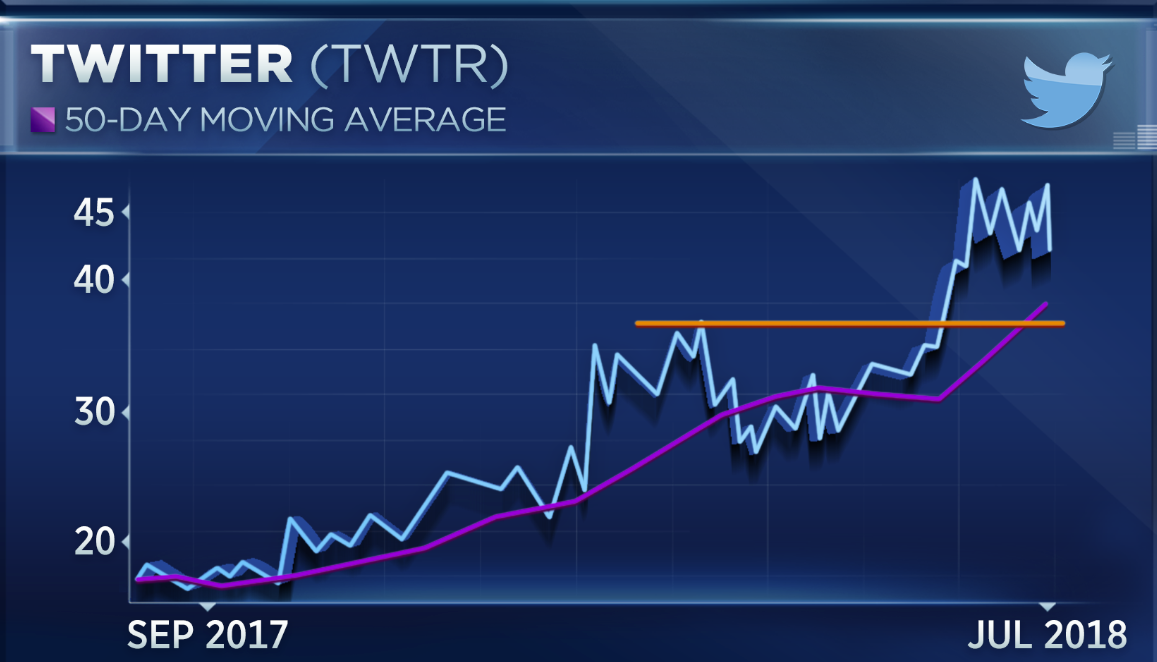
��This is obviously a substantial decline. ... Obviously alarming but at the same time not that rare,�� Frank Cappelleri, senior equity trader at Instinet, told CNBC��s ��Trading Nation�� on Monday.

Twitter shares moved lower by as much as 12 percent as recently as late March when the tech industry was still in the grips of a sell-off over data privacy. Since going public in November 2013, Twitter shares have fallen by more than 8 percent 19 times.

Twitter had dropped by nearly 10 percent at its session lows on Monday on reports it had suspended as many as 70 million fake accounts in May and June. It pared those losses on assurances from its chief financial officer and ended the session close to 6 percent lower. Its drop takes it back to levels seen in mid-June, a period that marked a new 52-week high.

Monday's pullback could be an opportunity to dive in, Cappelleri says.

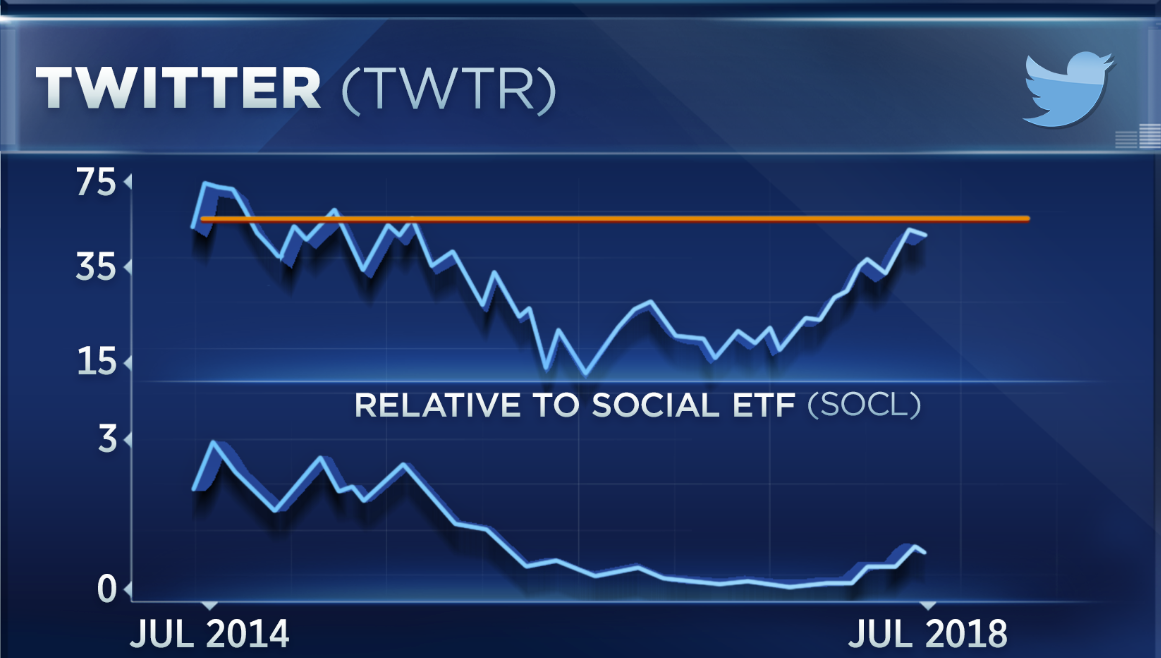
��I don��t know if we have to rally immediately but any time we see Twitter maybe pause near current levels and its breakout point [in June] you can come higher,�� he added. ��The SOCL, this social media ETF, Twitter is actually the biggest component of it and it��s just starting to outperform which I still think could be the beginning stages of doing so."

Twitter is up 83 percent for the year, while the SOCL social media ETF has added 11 percent.

Michael Bapis, managing director of The Bapis Group at Hightower Advisors, sees little of Monday��s sell-off affecting the company��s long-term prospects.

��We look at it as a light breather,�� Bapis said on Monday��s ��Trading Nation.�� ��We think going forward you still use the verb ��tweet�� and until somebody changes that we��re cautiously optimistic on the company.��

Twitter remains the best performer in the technology sector year to date. It has surged 145 percent over the past 12 months.

Vote Vote to see results Total Votes:

Not a Scientific Survey. Results may not total 100% due to rounding.

Disclaimer

Tuesday, July 10, 2018

Why You Should Never Get a Credit Card Advance

You need cash in a hurry, but you don't have the money in your bank account to cover it. Then you remember that your credit card allows you to take cash advances for a small fee. You breathe a sigh of relief and head over to the nearest ATM, not realizing that you're creating an even bigger problem for yourself.

A credit card cash advances is one of the most expensive ways to get extra money in a pinch. Not only can it cost you potentially hundreds of dollars in interest, but it can also lead to a vicious cycle of credit card debt that dings your credit score with each late or partial payment.

Here's a closer look at why you should stay away from credit card advances, as well as some better ways to get that extra cash.

Coins and dollar bills sitting in the middle of a bear trap

Image source: Getty Images.

The problem with cash advances

When you make a purchase with your credit card, you typically have a month to pay it off before it begins accruing interest. This isn't the case with cash advances. They begin accruing interest from day one, and the rates are often much higher than what you'd be charged for a credit card purchase. Purchase APRs usually fall somewhere between 10% and 20%, but it's not uncommon for cash advance APRs to be as high as 25%.

Then there are the cash advance fees to consider. Most companies charge between 2% and 5% of the cash advance amount, and some may have a minimum payment of $5 or $10 as well. This means you could end up paying an even higher percentage in fees if you're only borrowing a small amount. For example, 5% of $50 is $2.50, but if your card has a $10 minimum, you're now paying a 20% cash advance fee.

To put this all in perspective, consider a $1,000 cash advance. Let's assume there's a 25% APR and a 3% cash advance fee. So you'll immediately be charged an extra $30 for the privilege of receiving a cash advance. Then you'll begin accruing interest on that $1,000. If it takes you a year to pay it back, that means you'll end up paying an extra $250, which comes out to about $0.68 in interest per day. So in the end, that "convenient" cash advance cost you an extra $280.

Oh, and if you were hoping you'd at least get some credit card rewards for the cash advance, think again. You won't earn any rewards points, and if you fall behind on your payments, your card issuer will report this to the credit bureaus, which can lower your credit score.

Cash advance alternatives

If you need money in a hurry, there are better ways to get it than a cash advance. Here are a few suggestions.

If you only need a small amount, see if a family member or friend will lend it to you. Often, they won't charge you any interest at all, so this is a much more cost-effective solution than a cash advance. You should only do this if you're sure you can pay the loan back, though. It's a good idea to draw up the loan agreement in writing so that both of you can refer back to it if need be.

Another option is to see if your employer allows salary advances. Not all employers do, but this is one of your best bets for quick cash if it's available to you. Salary advances are your own money, so there are no lenders involved and no interest to pay back. But you should remember that your next paycheck will be smaller than usual.

You can also consider opting for a more traditional loan from a bank. If your credit is good, you'll probably find the rates to be more affordable than a credit card cash advance, and they could be as low as 5%. If you don't qualify for a personal loan from a bank, look into peer-to-peer lending instead. The credit requirements are usually less stringent, so it's easier to get approved. However, the interest rates are higher and can reach up to 30%, so this option may not end up being much more affordable than a cash advance.

Borrowing from your 401(k) or Roth IRA is also a possibility, though you should only do this as a last resort. For one, when you take money out of your retirement accounts, you're losing out on the opportunity to earn interest on that money. For another, you could end up paying more in taxes and fees. You must pay back any money taken from your IRA within 60 days or pay a 10% early-withdrawal penalty if you're under age 59 1/2. You have five years to pay back a 401(k) loan, but you'll also have to pay a low interest rate (typically around 4% or 5%). The good news is that the interest goes toward your retirement savings, not a creditor's pocket.

When you do the math, it's clear credit card cash advances just aren't a smart move. If you find yourself in a pinch, be sure to evaluate all of your options. Chances are, you'll find a more affordable solution that doesn't put you at risk of taking on expensive, high-interest debt.

Monday, July 9, 2018

Smart speaker maker Sonos files to go public

Speaker company Sonos has filed to go public.

The company plans to list shares on the Nasdaq under the ticker symbol "SONO," according to filings. It didn't specify how many shares would be up for sale or list an estimated offering price.

Sonos reported a net loss of $14.2 million on revenue of $992.5 million for the last fiscal year. That's an improvement from fiscal year 2016, when the company posted a net loss of $38.2 million on revenue of $901.3 million.

In fiscal year 2017, more than half of the company's revenue was generated outside the U.S.

For the six months ending March 31, Sonos reported revenue of $655.7 million, an 18 percent jump from the same period in 2017. Net income for the period totaled $13.1 million, a decrease of 14 percent from the year-ago period.

Sonos markets its high-end speakers to audiophiles and music-nuts as the speaker industry increasingly moves toward smart assistants like Amazon's and Google's offerings. Sonos introduced its first voice-enabled speaker, the Sonos One, late last year. It counts traditional speaker makers Bose and Samsung among its competitors, as well.

The company estimates its consumers listen to an average of 70 hours of content per month, according to the filing. As of March 31, Sonos counted more than 19 million registered products in nearly 7 million households globally.

Private equity firm KKR owns about 26 percent of the company, according to the filing. Index Ventures and co-founder and former CEO John McFarlane each own 13 percent.

Morgan Stanley, Goldman Sachs and Allen & Company are the lead underwriters for the offering.

More: Amazon Echo or Google Home? For U.S. households, that's changing

More: We asked Google Assistant, Amazon 's Alexa and Apple's Siri 150 questions. Here's who won.

More: Sonos plus Alexa makes for a smart �� and great-sounding �� speaker

Saturday, July 7, 2018

Insider Buying: GMS (GMS) Director Buys 2,000 Shares of Stock

GMS (NYSE:GMS) Director J David Smith purchased 2,000 shares of the stock in a transaction dated Monday, July 2nd. The shares were acquired at an average cost of $26.66 per share, for a total transaction of $53,320.00. Following the completion of the acquisition, the director now owns 4,000 shares of the company’s stock, valued at $106,640. The transaction was disclosed in a document filed with the SEC, which is available through the SEC website.

GMS traded down $0.13, reaching $26.00, during mid-day trading on Thursday, MarketBeat Ratings reports. 333,600 shares of the stock traded hands, compared to its average volume of 402,960. The stock has a market cap of $1.07 billion, a PE ratio of 13.00, a price-to-earnings-growth ratio of 1.12 and a beta of 1.53. The company has a debt-to-equity ratio of 1.00, a quick ratio of 1.69 and a current ratio of 2.71. GMS has a 12-month low of $23.50 and a 12-month high of $39.98.

Get GMS alerts:

GMS (NYSE:GMS) last posted its quarterly earnings data on Thursday, June 28th. The company reported $0.56 EPS for the quarter, missing analysts’ consensus estimates of $0.66 by ($0.10). The firm had revenue of $635.80 million for the quarter, compared to analysts’ expectations of $674.08 million. GMS had a net margin of 2.51% and a return on equity of 13.00%. The firm’s revenue was up 3.4% compared to the same quarter last year. During the same quarter last year, the company posted $0.48 EPS. sell-side analysts predict that GMS will post 3.34 EPS for the current fiscal year.

A number of research analysts have recently issued reports on GMS shares. TheStreet downgraded GMS from a “b-” rating to a “c” rating in a report on Thursday, June 28th. Zacks Investment Research downgraded GMS from a “buy” rating to a “hold” rating in a report on Tuesday, May 15th. ValuEngine downgraded GMS from a “hold” rating to a “sell” rating in a report on Thursday, June 28th. Seaport Global Securities raised GMS from a “neutral” rating to a “buy” rating and set a $40.00 price target on the stock in a report on Wednesday, March 7th. They noted that the move was a valuation call. Finally, Royal Bank of Canada set a $38.00 price target on GMS and gave the company a “buy” rating in a report on Wednesday, March 7th. One equities research analyst has rated the stock with a sell rating, two have given a hold rating, seven have assigned a buy rating and two have issued a strong buy rating to the company’s stock. The stock presently has an average rating of “Buy” and a consensus target price of $36.18.

Institutional investors have recently bought and sold shares of the stock. Thrivent Financial For Lutherans purchased a new stake in GMS during the fourth quarter valued at $1,685,000. Swiss National Bank increased its position in GMS by 29.7% during the fourth quarter. Swiss National Bank now owns 61,100 shares of the company’s stock valued at $2,300,000 after acquiring an additional 14,000 shares during the last quarter. Wells Fargo & Company MN increased its position in GMS by 12.0% during the fourth quarter. Wells Fargo & Company MN now owns 42,885 shares of the company’s stock valued at $1,614,000 after acquiring an additional 4,599 shares during the last quarter. Teachers Advisors LLC increased its position in GMS by 5.5% during the fourth quarter. Teachers Advisors LLC now owns 520,034 shares of the company’s stock valued at $19,574,000 after acquiring an additional 27,280 shares during the last quarter. Finally, BlackRock Inc. increased its position in GMS by 1.1% during the fourth quarter. BlackRock Inc. now owns 1,688,986 shares of the company’s stock valued at $63,572,000 after acquiring an additional 17,668 shares during the last quarter. Institutional investors own 74.04% of the company’s stock.

About GMS

GMS Inc distributes wallboards, suspended ceilings systems, and complementary interior construction products in North America. The company offers wallboard products; and ceilings products, such as suspended mineral fibers, soft fibers, and metal ceiling systems primarily used in offices, hotels, hospitals, retail facilities, schools, and other commercial and institutional buildings.

Insider Buying and Selling by Quarter for GMS (NYSE:GMS)

Friday, July 6, 2018

Pembina Pipeline (PBA) Cut to “Sell” at ValuEngine

ValuEngine cut shares of Pembina Pipeline (NYSE:PBA) (TSE:PPL) from a hold rating to a sell rating in a research note released on Monday.

Separately, Zacks Investment Research lowered Pembina Pipeline from a strong-buy rating to a hold rating in a research note on Wednesday, May 2nd. Two research analysts have rated the stock with a sell rating, two have given a hold rating and one has issued a buy rating to the company’s stock. The company presently has a consensus rating of Hold and an average target price of $37.00.

Get Pembina Pipeline alerts:

Shares of Pembina Pipeline opened at $34.68 on Monday, MarketBeat Ratings reports. The firm has a market cap of $17.47 billion, a P/E ratio of 26.08 and a beta of 0.66. Pembina Pipeline has a 12 month low of $29.28 and a 12 month high of $36.99. The company has a debt-to-equity ratio of 0.65, a quick ratio of 0.83 and a current ratio of 0.95.

Pembina Pipeline (NYSE:PBA) (TSE:PPL) last issued its earnings results on Thursday, May 3rd. The pipeline company reported $0.59 earnings per share (EPS) for the quarter, beating the Thomson Reuters’ consensus estimate of $0.45 by $0.14. The firm had revenue of $1.84 billion for the quarter, compared to analyst estimates of $1.92 billion. Pembina Pipeline had a return on equity of 10.07% and a net margin of 17.53%. The business’s revenue was up 24.1% on a year-over-year basis. During the same period in the previous year, the company posted $0.49 earnings per share. research analysts anticipate that Pembina Pipeline will post 1.95 EPS for the current year.

The company also recently announced a jun 18 dividend, which will be paid on Sunday, July 15th. Shareholders of record on Monday, June 25th will be paid a $0.19 dividend. The ex-dividend date is Friday, June 22nd. This represents a dividend yield of 5.08%. Pembina Pipeline’s payout ratio is presently 132.33%.

Institutional investors and hedge funds have recently modified their holdings of the business. SWS Partners bought a new stake in shares of Pembina Pipeline in the fourth quarter valued at $100,000. Icon Wealth Partners LLC bought a new stake in shares of Pembina Pipeline in the fourth quarter valued at $103,000. Cubist Systematic Strategies LLC raised its stake in shares of Pembina Pipeline by 73.9% in the first quarter. Cubist Systematic Strategies LLC now owns 6,085 shares of the pipeline company’s stock valued at $190,000 after buying an additional 2,585 shares during the period. BB&T Securities LLC bought a new stake in shares of Pembina Pipeline in the fourth quarter valued at $200,000. Finally, Marco Investment Management LLC bought a new stake in shares of Pembina Pipeline in the fourth quarter valued at $202,000. Hedge funds and other institutional investors own 45.54% of the company’s stock.

About Pembina Pipeline

Pembina Pipeline Corporation provides transportation and midstream services for the energy industry in North America. It operates through three divisions: Pipelines, Facilities, and Marketing & New Ventures. The company operates approximately 10,000 kilometers of pipeline network that transports hydrocarbon liquids and extends across Alberta and parts of British Columbia, Saskatchewan, and North Dakota; and owns and operates the Nipisi and Mitsue pipelines, which provide transportation for producers operating in the Pelican Lake and Peace River heavy oil regions of Alberta; transports synthetic crude oil for the Syncrude project and the Horizon project to delivery points near Edmonton, Alberta; and operates Cheecham Lateral, which transports synthetic crude to oil sands producers operating southeast of Fort McMurray, Alberta.

To view ValuEngine’s full report, visit ValuEngine’s official website.

Thursday, July 5, 2018

DigitalPrice (DP) Market Capitalization Tops $1.04 Million

DigitalPrice (CURRENCY:DP) traded down 0% against the US dollar during the 1-day period ending at 20:00 PM E.T. on July 4th. During the last seven days, DigitalPrice has traded 12.7% lower against the US dollar. One DigitalPrice coin can now be purchased for $0.0523 or 0.00000796 BTC on major exchanges including CoinExchange and Cryptopia. DigitalPrice has a market capitalization of $1.04 million and $1,534.00 worth of DigitalPrice was traded on exchanges in the last day.

Here is how other cryptocurrencies have performed during the last day:

Get DigitalPrice alerts: Aston (ATX) traded 0.8% lower against the dollar and now trades at $0.0491 or 0.00000746 BTC. Pura (PURA) traded 3.8% higher against the dollar and now trades at $0.0947 or 0.00001439 BTC. Polis (POLIS) traded 1% lower against the dollar and now trades at $1.14 or 0.00017389 BTC. ArcticCoin (ARC) traded down 12.8% against the dollar and now trades at $0.0422 or 0.00000513 BTC. Adzcoin (ADZ) traded 0.4% lower against the dollar and now trades at $0.0181 or 0.00000276 BTC. Advanced Technology Coin (ARC) traded down 6.3% against the dollar and now trades at $0.0232 or 0.00000353 BTC. Onix (ONX) traded 0.5% lower against the dollar and now trades at $0.0049 or 0.00000074 BTC. Startcoin (START) traded up 1.7% against the dollar and now trades at $0.0088 or 0.00000134 BTC. Prime-XI (PXI) traded up 1.7% against the dollar and now trades at $0.0045 or 0.00000069 BTC. Uro (URO) traded flat against the dollar and now trades at $0.0411 or 0.00000536 BTC.

DigitalPrice Profile

DigitalPrice is a proof-of-work (PoW) coin that uses the X11 hashing algorithm. Its launch date was April 21st, 2016. DigitalPrice’s total supply is 27,280,675 coins and its circulating supply is 19,780,674 coins. DigitalPrice’s official Twitter account is @DigitalPriceOrg and its Facebook page is accessible here. DigitalPrice’s official website is digitalprice.org. The Reddit community for DigitalPrice is /r/DigitalPriceOrg and the currency’s Github account can be viewed here.

DigitalPrice Coin Trading

DigitalPrice can be purchased on these cryptocurrency exchanges: CoinExchange and Cryptopia. It is usually not currently possible to buy alternative cryptocurrencies such as DigitalPrice directly using U.S. dollars. Investors seeking to acquire DigitalPrice should first buy Ethereum or Bitcoin using an exchange that deals in U.S. dollars such as Coinbase, GDAX or Changelly. Investors can then use their newly-acquired Ethereum or Bitcoin to buy DigitalPrice using one of the exchanges listed above.

Sunday, June 24, 2018

Fox News commentator apologizes for racist remark

Fox News is distancing itself from a racist remark made by one of its paid commentators on Sunday.

The commentator, David Bossie, was arguing on "Fox & Friends" with Democratic strategist Joel Payne, who is black. He told Payne, "you're out of your cotton-picking mind."

Payne was stunned by the remark. He told Bossie he had "some relatives who picked cotton, and I'm not going to sit back and let you attack me on TV like that."

Bossie, a veteran conservative activist, was a deputy campaign manager on the Trump campaign. He also served as a deputy director of Trump's transition team. He joined Fox News in February 2017.

Fox declined to comment on whether Bossie would be suspended in the wake of the on-air controversy.

But in a statement, a Fox News spokesperson said "David Bossie's comments today were deeply offensive and wholly inappropriate. His remarks do not reflect the sentiments of Fox News and we do not in any way condone them."

Payne, appearing on MSNBC later in the day, said he had a "terse" exchange with Bossie immediately after the Fox News panel. He expressed "some regret," Payne said.

Four and a half hours after the TV segment, Bossie tweeted an apology.

"During a heated segment on 'Fox & Friends' today, I should have chosen my words more carefully and never used the offensive phrase that I did," he wrote. "I apologize to Joel Payne, Fox News and its viewers."

Payne said during his MSNBC interview that he accepted the apology in Bossie's tweet, but said his comments have prompted "frustration" among minorities.

"My namesake is my great-grandfather, who was a sharecropper," he said. "I took that very personally."

"Our family and people like us have worked very hard to come up over the years. And so, to have someone kind of reduce our experience and try to make light of that experience �� which I imagine Mr. Bossie was doing �� that was offensive and that was unacceptable to me," Payne said.

The banner on screen during the Fox News segment said "PUNDITS CALL TRUMP SUPPORTERS RACIST, NAZIS." The segment was supposed to be all about heated rhetoric.

After the "cotton picking" comment, Bossie again said to Payne, "You're out of your mind."

"Let's end it on a civil note," host Ed Henry said.

He moved on, but came back after a break to "address what just happened."

"I want to make clear Fox News and this show, myself, we don't agree with that particular phrase," Henry said. "It was obviously offensive, and these debates get fiery. That's unfortunate."

Saturday, June 9, 2018

A Pair Trade In E&P: Bernstein Upgrades ConocoPhillips, Downgrades Concho

The Permian basin space is becoming overcrowded, resulting in a situation where survival and growth are increasingly difficult, according to Bernstein. 

The Permian basin is a large oil-producing basin situated in the western part of Texas and the southeastern part of New Mexico, and comprises of several component basins, including the Midland and Delaware basins. 

Given the evolving scenario, Bernstein identified a pair trade in the North American oil and gas exploration sector. 

The Analyst

Analyst Bob Brackett upgraded shares of ConocoPhillips (NYSE: COP) from Market Perform to Outperform with a $82 price target.

The analyst downgraded shares of Concho Resources Inc (NYSE: CXO) from Outperform to Market Perform and lowered the price target from $180 to $130.

ConocoPhillips: FCF Growth, Low Permian Exposure Turn Bernstein Bullish

ConocoPhillips' global portfolio and Brent pricing will insulate it from congestion that's impacting other E&Ps, with its scope of operations acting as a natural hedge, Brackett said in a Friday note.

The company has a low exposure to the Permian, with the basin accounting for only 4-5 percent of its overall production, the analyst said. 

Better free cash flow yield relative it to E&P peers and capital discipline that helps to maintain production cost at $40/barrel are major positives, Brackett said. 

Higher prices lead to better growth, which could push ConocoPhillips' market capitalization higher, according to Bernstein.

Related Link: Energy Sector Earns An Upgrade

26% Below Consensus On Concho

Concho is exposed by roughly 15 percent on flows in 2018, with over 50 percent exposure on price, Brackett said.

Despite a forward curve showing the basis peaking in late 2018, the situation is likely to persist for the next four to six quarters, the analyst said. 

Brackett sees the RSP Permian Inc (NYSE: RSPP) deal as a a good strategic move that benefits the companies long-term. 

"We think, on average, investors will wait and see on CXO (especially 2Q earnings results) and as such we think investors can find a better entry point into a strong equity story." 

Bernstein is 26 percent below Street estimates on 2019 cash flow per share. 

The Price Action

ConocoPhillips shares were down 0.19 percent at the time of publication Friday afternoon, while Concho Resources was down 2 percent at $127.71. 

Related Link:

Jim Cramer Gives His Opinion On ConocoPhillips, Texas Instruments And More

Photo by Zorin09/Wikimedia. 

Latest Ratings for COP DateFirmActionFromTo
Jun 2018MizuhoInitiates Coverage OnNeutral
Jun 2018BernsteinUpgradesMarket PerformOutperform
Apr 2018BarclaysMaintainsOverweightOverweight

View More Analyst Ratings for COP
View the Latest Analyst Ratings

Tuesday, May 29, 2018

Inditex (ITX) Given a €30.30 Price Target at Kepler Capital Markets

Inditex (BME:ITX) received a €30.30 ($35.23) price objective from stock analysts at Kepler Capital Markets in a report issued on Tuesday. The brokerage presently has a “buy” rating on the stock. Kepler Capital Markets’ target price suggests a potential upside of 17.62% from the stock’s previous close.
Other equities analysts also recently issued research reports about the stock. Royal Bank of Canada set a €30.00 ($34.88) price target on shares of Inditex and gave the stock a “buy” rating in a research note on Wednesday, March 14th. Barclays set a €34.00 ($39.53) price target on shares of Inditex and gave the stock a “buy” rating in a research note on Tuesday, March 13th. Jefferies Group set a €31.00 ($36.05) target price on shares of Inditex and gave the company a “buy” rating in a research note on Thursday, May 24th. Deutsche Bank reissued a “buy” rating and issued a target price on shares of Inditex in a research note on Thursday, March 15th. Finally, Berenberg Bank set a €22.00 ($25.58) target price on shares of Inditex and gave the company a “sell” rating in a research note on Thursday, March 15th. Two analysts have rated the stock with a sell rating, three have given a hold rating and fifteen have given a buy rating to the company’s stock. Inditex has an average rating of “Buy” and an average target price of €32.49 ($37.78).

Get Inditex alerts:

Inditex opened at €25.76 ($29.95) on Tuesday, MarketBeat reports. Inditex has a fifty-two week low of €23.00 ($26.74) and a fifty-two week high of €36.90 ($42.91).

Inditex Company Profile

Industria de Diseno Textil SA, known as Inditex SA, is a Spain-based company primarily engaged in the textile industry. The Company��s activities include the design, confection, manufacturing, distribution and retail of men, women and children apparel, footwear and fashion accessories, as well as home furnishings and household textile products.

Analyst Recommendations for Inditex (BME:ITX)

Sunday, May 27, 2018

Rivals Rise Up to Threaten Tesla's Battery Business

Batteries to run cars. Batteries to store solar power. Batteries ... to prevent blackouts.

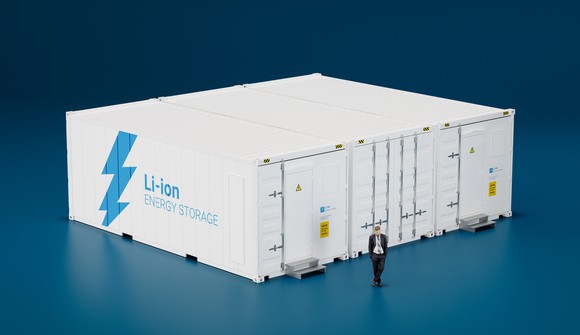
Everywhere you look in the field of battery technology,�Tesla (NASDAQ:TSLA) seems to be there already. The company's even building a battery�gigafactory in the Nevada desert�to keep its battery empire well-supplied, and one of the reasons for this is that Tesla is rapidly outgrowing its origins as a car company, and finding new ways to make money by building huge, utility-scale energy storage complexes to help electricity companies shore up the stability of their electric grids.

It's a lucrative business -- and Lockheed Martin (NYSE: LMT) wants in.

Lithium battery storage warehouse

Lithium ions are great for storing electricity, but does a utility really need to use ultra-lightweight, ultra-expensive lithium? Image source: Getty Images.

Lockheed looks for electricity

Last month, Lockheed Martin (NYSE:LMT) announced that it's found a way to make storage batteries for a whole lot cheaper than what lithium-ion batteries currently cost -- by forgoing the lithium.

Now, Lockheed might seem a strange candidate to come up with such a plan. Most investors probably know Lockheed Martin only as a defense giant. And yet, Lockheed Martin also has an active side business in green and renewable technologies, covering everything from generating power from ocean waves to filtering out salt to create potable water�to�nuclear fusion.

And this is the direction in which Lockheed is leaning with its latest venture. As explained in a�Reuters�story, Lockheed is working to develop a "flow" battery that utilities can use to store their energy and stabilize their electric grids. Because utilities tend to be geographically grounded, and not move around a lot, light-weighing lithium metal isn't a sine qua non in the batteries they use. Simply put, cost trumps lightness when it comes to building utility-scale batteries.

Playing to this strength, Lockheed says its new battery technology will be made from nontoxic rare-earth metals and chemicals dissolved in a water solution to hold their charge. These materials will be cheap, but not necessarily lightweight like lithium.

Context: Competition is heating up for Tesla

Will Lockheed Martin's new battery initiative upset Tesla's recent success in building utility-scale batteries? Actually, Tesla is already encountering some competition here. After winning one Australian energy storage deal (for 129 megawatts) last year, then a second (for 250 megawatts of "distributed" storage) this year, Tesla was tapped a third time to build a 25 megawatt energy storage facility co-located with the Gannawarra Solar Farm near Kerang, Victoria. (Tesla has also built a smaller 20 megawatt battery system supporting a wind farm at the Bulgana Green Power Hub in Western Victoria.)

These weren't the only energy storage projects that came up for bid recently, however. Yet another project -- 30 megawatts of storage -- was awarded to AES (NYSE:AES) and Siemens' (NASDAQOTH:SIEGY) joint venture Fluence, a start-up those companies set up specifically to compete with Tesla in this growing market. It will be installed at�the Ballarat terminal station, owned by AusNet, and operated by EnergyAustralia.

Fluence offers storage in three formats: "Siestorage" (billed as providing "lightning fast energy"), Advancion (designed for "dependability"), and SunFlex (tailored to provide "maximum solar yield") -- each apparently utilizing lithium-ion batteries such as Tesla uses. The company has not revealed which of these solutions will be employed in Australia.

Fluence, incidentally, is also the company behind the biggest energy storage project in Tesla's home market of the United States. In January, AES and Siemens announced�they received the necessary "approvals and authorizations" to proceed with a "100 MW/400 MWh"�energy storage project in Long Beach, California, dubbed the Alamitos power center energy storage project. Said project will provide backup power to Southern California Edison in western Los Angeles.

Why it matters to investors

As I've pointed out previously, Tesla's energy storage business produces better gross margins than its better-known electric car business -- where Tesla's also been feeling some heat from the competition as General Motors' electric Bolt steals sales from impatient would-be Tesla Model 3 buyers, and Volkswagen gears up for a major push into electric vehicles.�Now, as Tesla faces down a whole host of imitators in the electric car market, its more profitable energy storage business is also coming under attack -- an attack that will only get more intense when Lockheed brings its new flow batteries to market next year.

With AES, Siemens, and now Lockheed Martin gunning for Tesla's surprisingly successful energy storage business, things could soon be looking grim for Tesla.

Saturday, May 26, 2018

Top 5 Warren Buffett Stocks To Invest In 2018

tags:TRP,CDE,CLSD,CRM,CBT,

Warren Buffett famously made billions of dollars investing in Coca-Cola (NYSE:KO) because he recognized the intangible value of its brand. Coke's brand not only drew customers and enticed them to pay premium prices over generic brands for what is mostly flavored sugar-water but the brand also acts as a "moat" around the company, as it would be extremely difficult for a new entrant to create a comparable brand to erode away Coca-Cola's profits. Another story, whose source I haven't been able to verify, is that Warren was once asked how he would put Coca-Cola out of business if he had a $100 billion budget to do so, to which he replied that he would give back the $100 billion admitting he could not do it.

A recently updated map from HowMuch.net ranking the world's most valuable brands by country in 2017 shows that Apple Inc. (AAPL) lost its spot as the US's most valuable brand. Of these, the top 10 most valuable brands with shares or ADRs traded in the US are:

US-based search engine and Google parent Alphabet Inc (GOOG) (NASDAQ:GOOGL) Swiss food giant Nestle (OTCPK:NSRGF) Korea's Samsung Electronics (OTC:SSNLF) - part of a larger group of Samsung brands China's (and the world's) largest bank ICBC (OTCPK:IDCBF) Japanese automaker Toyota (TM) Irish medical equipment maker Medtronic (MDT) Royal Dutch Shell, the oil company (RDS.A) Royal Bank of Canada (RY) Spanish bank Santander (SAN), and Hong Kong-based insurer AIA (OTCPK:AAGIY)

In 11th and 12 place, by market cap, are British telecom Vodafone Plc (VOD) and German automaker BMW (OTCPK:BMWYY), whose brands are valued at 2-4x AIA's according the map, but whose market caps trade at significantly lower multiples in the current market environment.

Top 5 Warren Buffett Stocks To Invest In 2018: Transcananda Pipelines Ltd.(TRP)

Advisors' Opinion:
  • [By Paul Ausick]

    In addition to the Trans Mountain system, two other pipeline projects currently are proposed to move crude oil from Alberta either to the Great Lakes or the Gulf Coast. Enbridge Inc. (NYSE: ENB) is proposing to replace its 50-year old Line 3 system to transport 760,000 barrels a day to Superior, Wisconsin. TransCanada Corp. (NYSE: TRP) has received approval from the Trump administration and would transport 830,000 barrels a day to Nebraska where existing pipelines will take over, sending the crude to U.S. refineries and Gulf Coast terminals.

  • [By Matthew DiLallo]

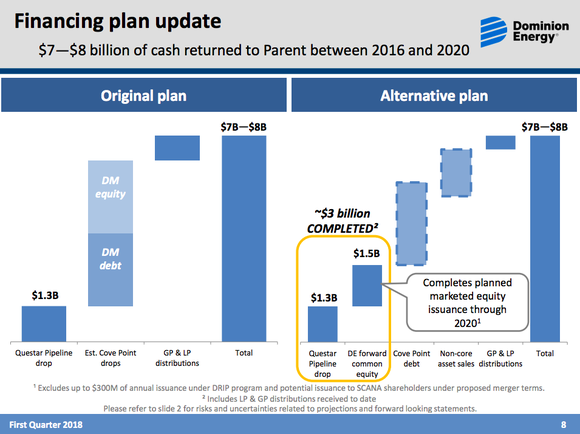
    Most investors have probably heard of energy giants Royal Dutch Shell (NYSE:RDS-A) (NYSE:RDS-B), Dominion Energy (NYSE:D), and TransCanada (NYSE:TRP). Fewer, however, are likely familiar with their publicly traded master limited partnerships (MLPs): Shell Midstream Partners (NYSE:SHLX), Dominion Energy Midstream Partners (NYSE:DM), and TC Pipelines (NYSE:TCP). That might be a good thing, as the market has beaten up the latter trio this year, sending their valuations south.

  • [By Matthew DiLallo]

    TransCanada (NYSE:TRP) is a dividend lovers' dream stock. The Canadian pipeline giant has increased its payout for 18 straight years, including 10.4% for 2018, and it now yields nearly 5%. There's still plenty more growth coming down the pipeline given its forecast that the company can increase the payout at an 8% to 10% annual rate through at least 2021. That outlook is among the best in its peer group.

  • [By Stephan Byrd]

    TransCanada (NYSE: TRP) and Transportadora de Gas del Sur (NYSE:TGS) are both oils/energy companies, but which is the better stock? We will contrast the two companies based on the strength of their dividends, analyst recommendations, institutional ownership, risk, profitability, earnings and valuation.

  • [By Zacks]

    Moreover, TransCanada Corporation (NYSE: TRP)'s $8 billion Keystone XL pipeline – expected to carry heavy crude from Alberta to refineries in the United States – is yet to get a final investment decision. The midstream company had secured 20 years commitment for 500 thousand barrels per day for the pipeline and received Alberta government's support. However, the Nebraska government sanctioned the Mainline Alternative Route for the controversial project, which is longer than the company's preferred route and has forced it to review the alternative route keeping the final decision on hold.

Top 5 Warren Buffett Stocks To Invest In 2018: Coeur d'Alene Mines Corporation(CDE)

Advisors' Opinion:
  • [By Reuben Gregg Brewer]

    There's no way to sugarcoat it:�2017 was not a particularly good year for shareholders of silver and gold miner Coeur Mining, Inc. (NYSE:CDE). When it comes to investing, though, you need to balance the past with the future, and this miner's efforts in 2017 look like they will set up a much better long-term future. Here's why precious metals investors should be taking a closer look at Coeur Mining, but probably shouldn't rush to pull the trigger.

Top 5 Warren Buffett Stocks To Invest In 2018: Clearside BioMedical, Inc. (CLSD)

Advisors' Opinion:
  • [By Keith Noonan]

    Clearside Biomedical, Inc. Stock (NASDAQ:CLSD)�stock rose 66.1% in March, according to data provided by�S&P Global Market Intelligence.

Top 5 Warren Buffett Stocks To Invest In 2018: Salesforce.com Inc(CRM)

Advisors' Opinion:
  • [By ]

    Off the IBM letdown, cloud names like Salesforce (CRM) and Adobe (ADBE) look to be the wise bets.

    WTF With Tesla

    At this rate, 'Jolt' will become nothing more than a morning Tesla (TSLA) blog that so happens to be delivered straight to your email inbox. Keeping up with the daily news flow on Elon Musk's car creation is becoming darn near impossible. There is around-the-clock speculation on production goals. People hop into chat rooms to complain about Model 3 build quality and factory working conditions. Musk always looms large on Twitter. There are YouTube videos of people passing parking lots filled with just produced Model 3s.

  • [By Danny Vena]

    The company may not be a household name, but if you have any doubts about its pedigree, you should know that Magento was identified as a leader by Gartner's Magic Quadrant for digital commerce, joining such well-known names as Oracle, IBM, and Salesforce.com (NYSE:CRM).�The company also provides a suite of tools designed for business-to-business (B2B) transactions, and it was identified last year as a leader in the field by Forrester Research.�

  • [By ]

    Oracle (ORCL) : "I think Oracle is fine, but I still favor Salesforce.com (CRM) ."

    PayPal (PYPL) : "I think PayPal is best in show. PayPal goes much higher. "

  • [By Joseph Griffin]

    Salesforce.com (NYSE:CRM) had its price target increased by JMP Securities from $126.00 to $140.00 in a research note published on Tuesday. The brokerage currently has a market outperform rating on the CRM provider’s stock.

  • [By ]

    Disney (DIS) , Expedia (EXPE) , Turner, Comcast (CMCSA) , GoDaddy (GDDY) , GE (GE) , Capital One (COF) , Netflix (NFLX) (yes, Netflix) Salesforce.com (CRM) and Workday (WDAY) disclosed similar moves in the past. While other business units and large enterprises followed the same path, but chose to keep them private.

  • [By Lee Jackson]

    This top company reported solid fiscal 2018 second-quarter results as billings drastically improved, and it is on the Merrill Lynch US 1 list.�Salesforce.com Inc. (NYSE: CRM)�provides enterprise cloud computing solutions, with a focus on customer relationship management to various businesses and industries worldwide.

Top 5 Warren Buffett Stocks To Invest In 2018: Cabot Corporation(CBT)

Advisors' Opinion:
  • [By Lisa Levin]


    Companies Reporting After The Bell Hertz Global Holdings, Inc. (NYSE: HTZ) is projected to post quarterly loss at $1.31 per share on revenue of $1.97 billion. International Flavors & Fragrances Inc. (NYSE: IFF) is estimated to post quarterly earnings at $1.59 per share on revenue of $909.36 million. Zillow Group, Inc. (NASDAQ: ZG) is expected to post quarterly earnings at $0.06 per share on revenue of $294.79 million. General Cable Corporation (NYSE: BGC) is estimated to post quarterly earnings at $0.15 per share on revenue of $980.61 million. Central Garden & Pet Company (NASDAQ: CENT) is expected to post quarterly earnings at $0.84 per share on revenue of $598.45 million. Cabot Corporation (NYSE: CBT) is estimated to post quarterly earnings at $1 per share on revenue of $746.42 million. Fabrinet (NYSE: FN) is expected to post quarterly earnings at $0.71 per share on revenue of $319.71 million. National General Holdings Corp. (NASDAQ: NGHC) is projected to post quarterly earnings at $0.55 per share on revenue of $1.08 billion. The Navigators Group, Inc. (NASDAQ: NAVG) is estimated to post quarterly earnings at $0.75 per share on revenue of $320.92 million. Diplomat Pharmacy, Inc. (NYSE: DPLO) is expected to post quarterly earnings at $0.22 per share on revenue of $1.29 billion. Trex Company, Inc. (NYSE: TREX) is projected to post quarterly earnings at $1.19 per share on revenue of $172.22 million. AMC Entertainment Holdings, Inc. (NYSE: AMC) is expected to post quarterly earnings at $0.09 per share on revenue of $1.35 billion. Envision Healthcare Corporation (NYSE: EVHC) is projected to post quarterly earnings at $0.64 per share on revenue of $2.02 billion. Regal Beloit Corporation (NYSE: RBC) is estimated to post quarterly earnings at $1.23 per share on revenue of $869.64 million. Amedisys, Inc. (NASDAQ: AMED) is projected to post quarterly earnings at $0.67 per share on revenue of $39
  • [By Taylor Cox]

    Investor Events

    Analyst/investor days for: PayPal Holdings, Inc (NASDAQ: PYPL), Cabot Corporation (NYSE: CBT), S&P Global Inc (NYSE: SPGI), Total System Services, Inc (NYSE: TSS), and TTM Technologies, Inc (NASDAQ: TTMI) Roku, Inc (NASDAQ: ROKU) annual shareholder meeting Equifax Inc (NYSE: EFX) will meet with investors in L.A.

    Friday

Friday, May 25, 2018

New Oriental Education: A Bet On Chinese Education

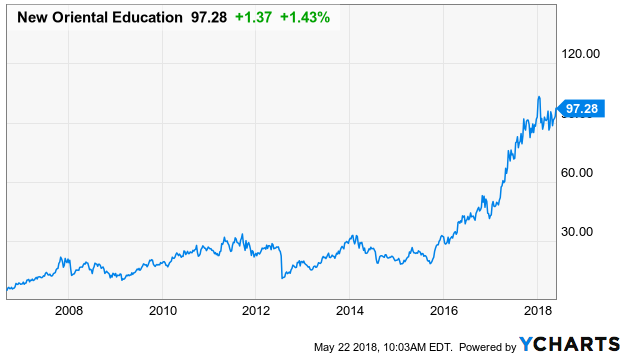
New Oriental Education (EDU) is seeing its share price break out higher as the company continues to experience strong growth trends in demand for Chinese education. As demand for higher education remains a priority in China, EDU is capitalizing on such momentum by offering expanded offerings and learning programs. Its share price is similarly trending higher, backed by improving fundamental results. I am buying stock in the name as investor optimism continues to be backed by its stronger fundamental operations.

Fundamental Narrative

As demand for education continues to expand in China, opening up opportunities for its students across the globe, EDU is expanding its operations, capitalizing on the momentum.

The company provides private educational services under the New Oriental brand in the People's Republic of China. It operates through Language Training and Test Preparation, Primary and Secondary School Education, Online Education, Content Development and Distribution, Pre-School Education, Overseas Study Consulting Services, and Study Tour segments.

They also offer test preparation courses to students taking language and entrance exams used by educational institutions in the United States, the People's Republic of China, and the Commonwealth countries; and after-school tutoring courses for middle and high school students to achieve better scores on entrance exams for admission into high schools or higher education institutions, as well as for children to teach English.

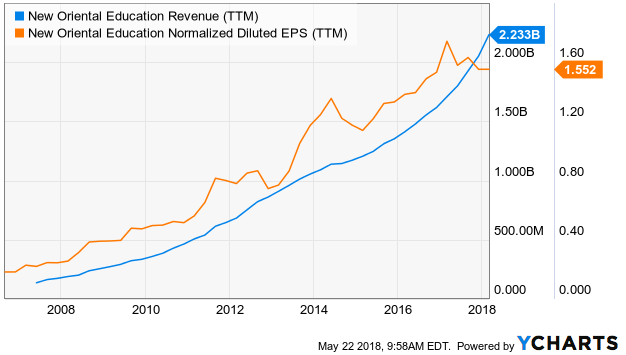
EDU continues its strong momentum in driving top line growth over the last quarter, with net revenues increasing to $618.1 million, representing 41.2% annualized growth. Strong top-line growth was driven by recent increases in student enrollments in academic subjects tutoring and test prep courses over the last two quarters. This is leading to strong results in terms of the enrollment in cash proceeds from students' registration, which grew year-over-year by approximately 40%, according to its earnings call.

The strong demand for education is being driven by students desire to explore different parts of the world, gaining opportunities abroad. These opportunities come into existence for students who can achieve high marks on entrance exams like the SAT or ACT. Strong demand for education is thus leading to rapid expansion for the company, who continues to open new locations. Over the last quarter, EDU added a net of 47 learning centers in 23 existing cities. They also opened two new schools in cities Lianyungang and Yancheng, while launching three dual-teacher model schools and eight learning centers in the cities of Jiaozuo, Dongguan and Haikou, according to management. Put together, its total square meters of classroom area by the end of the most recent quarter expanded by approximately 41% year-over-year.

Moreover, EDU continues to invest in its pure online education platform, Koolearn.com, which delivered a year-over-year revenue growth of approximately 63% in the most recent quarter, with registered users and paid users up by approximately 88% and 70% respectively. By investing in online technology, EDU is able to reach more students in remote locations who can't necessarily make it into a physical location. This is leading to increasing support in resources and a series of new initiatives being rolled out that is leading its online K-12 after-school tutoring business to experience robust year-over-year revenue growth of approximately 176%.

In order to capture the growth opportunities in lower-tier cities in China, EDU rolled out its dual-teacher model schools, while expanding its business into remote areas of China. The dual-teacher model is when a teacher in one location, usually a major city, offers a live lecture to students in remote areas while a tutor provides additional support from the physical classroom. They began to pilot the new dual-teacher model class in select cities in July 2016 and by the end the most recent quarter, they have deployed the new offering in over 35 existing cities, according to management.

Below is a chart of the company's revenue and earnings per share. EDU's growth trajectory has been spectacular since its inception. Revenue has gone from below $500 million, to now over $2 billion. Moreover, EPS has exponentially risen from under $0.40 per share, to now over $1.5 per share. The company is able to capitalize on strong demand for educational services within the country by boosting its top- and bottom-line results, potentially fueling further share price gains.

Price Action

EDU remains in a strong trend higher, even amid a recent consolidation. From 2016 to present, the company's share price is up nearly threefold due to explosive top- and bottom-line growth. Recent volatility in broader equity markets led to a pullback in the name, but its fundamental strength continues to lift it higher. EDU's breakout above the $100 level was significant, as this level had acted as resistance in recent months. With its stock resuming its uptrend backed by strong operational momentum, the rally could last over coming quarters.


Conclusion

EDU is breaking out higher as the company continues to experience strong growth trends. As demand for education remains a priority in China, EDU is capitalizing such momentum. Its share price is similarly trending higher, backed by improving fundamental results. I am buying stock in the name as investor optimism continues to be backed by stronger fundamental operations.

Markets move quickly. To take advantage of the highs and lows - especially in today's volatile environment - you need a strategy that's nimble and flexible. My approach is both, and it enables me to move in and out of assets and sectors while continually generating double-digit annualized returns. Sign up for Absolute Returns today to see how I manage my portfolio in the continuously changing market environment. Many believe absolute returns and beating the market are mere fiction, but I assure you they're not. See for yourself how you can benefit from my approach, and how your portfolio can profit, regardless of market conditions.

Disclosure: I am/we are long EDU.

I wrote this article myself, and it expresses my own opinions. I am not receiving compensation for it (other than from Seeking Alpha). I have no business relationship with any company whose stock is mentioned in this article.

Thursday, May 24, 2018

I Don't Buy the Bull Case for J.C. Penney

It's been a rough few days for struggling department store chain J.C. Penney (NYSE:JCP). The retailer's first-quarter report on May 17 was a disappointment, featuring almost non-existent comparable sales growth, a tumbling gross margin, and a big loss. Given that this came a day after Macy's put up some solid numbers, it's clear that J.C. Penney isn't benefiting from the strong consumer spending that its rival is seeing.

On May 22, J.C. Penney CEO Marvin Ellison abruptly resigned to take the CEO job at Lowe's. In his time leading J.C. Penney, Ellison pushed the company into the appliance business, added toys to the stores, and expanded the number of Sephora shops. Unfortunately, none of these steps have had any real impact on the company's performance.

An appliance showroom at a J.C. Penney store.

Image source: J.C. Penney.

With J.C. Penney's turnaround showing no signs of progress, is there any reason to buy the stock? The only bullish argument left, in my opinion, is the idea that the demise of Sears Holdings (NASDAQ:SHLD) and other big-box chains will push sales into J.C. Penney's lap. The company's appliance strategy is tailor-made to pick up some of the sales that Sears is losing as it circles the drain.

J.C. Penney may enjoy a sales boost as other retailers fail. But as an investment thesis, that's about as weak as it gets.

Grasping at straws

Imagine if I pitched you this investment idea:

Company A is failing more slowly than Company B. They sell some of the same stuff. Buy Company A!

Not very convincing, is it?

Sears was still the No. 3 appliance retailer in the U.S. as of a year ago despite how awful that company has been performing. J.C. Penney doesn't disclose appliance sales, but they're probably a drop in the bucket at this point, given how recently the retailer entered the market. Sales in the home category, which includes appliances, home decor, furniture, electronics, cookware, and a wide variety of other products, accounted for 15% of sales in 2017.

The hope is that J.C. Penney will be able to pick up a considerable percentage of appliance sales that Sears sheds, helping to offset weak sales in other categories, particularly women's apparel. The company will likely pick up some appliance sales. But the assumption that it will be enough to matter seems like a stretch to me.

Lowe's and Home Depot are the top two appliance retailers in the U.S. Each has thousands of stores spread across the country. I'd expect Lowe's and Home Depot to benefit the most as Sears hemorrhages market share. Best Buy was the No. 4 appliance retailer a year ago, and its appliance business has been growing at a brisk pace. During the fourth quarter of 2017, Best Buy's domestic appliance business put up comparable-sales growth of more than 20%. The company is wasting no time scooping up market share as Sears stumbles to its end, and there's only so much to go around.

For J.C. Penney to win a lot market share, it has to convince customers that it's a better choice for appliances than Lowe's, Home Depot, and Best Buy. That's a tall order. How many people are even aware that J.C. Penney sells large appliances? Of those, how many would ever consider stepping into a J.C. Penney store to buy a refrigerator?

This isn't to say that J.C. Penney can't build a respectable appliance business. I just don't think it will be easy. The idea that J.C. Penney will be awash in new appliance customers because it has stores nearby closing Sears locations completely ignores the competition.

Will J.C. Penney benefit from the collapse of Sears? Sure. Will it be enough to ignite a turnaround and put it on a path to consistent and sustainable growth? I doubt it.

Wednesday, May 23, 2018

3 Top Utility Stocks for Dividend Growth Investors

Regulated utilities make a big trade-off. They get a monopoly, but have to get their rates approved by the government. That often leads to slow but steady earnings and dividend growth over time. However, some utilities have been able to separate themselves from the slow-growth crowd. For example, American Water Works Company Inc. (NYSE:AWK), NextEra Energy Inc. (NYSE:NEE), and Dominion Energy Inc. (NYSE:D) are all targeting 10% dividend growth over the next few years. Here's a quick primer on each, if dividend growth that's three times the historical rate of inflation sounds good to you.

1. A water giant

American Water Works serves 1,600 communities in the United States and parts of Canada. It provides drinking water and wastewater services. The company's customers literally can't live without the water it provides. Growth comes from two main sources: upgrading its assets and acquiring new water systems in the highly fragmented water services industry.� �

A worker standing in front of high voltage power equipment

Image source: Getty Images.

Spending to upgrade old water pipes is generally looked at favorably by regulators and helps get rate hikes approved. American Water Works plans to spend around $8 billion, largely on capital projects, over the next five years. That should help drive earnings higher by as much as 7%. Acquisitions, meanwhile, could add as much as two percentage points to the company's earnings growth (its nonregulated business could add another percentage point or two beyond that) and push spending up as high as $9 billion. And there are plenty of opportunities to buy assets -- American Water Works is the largest publicly traded water company, yet operates in only 16 states.�

All of that spending is expected to help American Water Works expand earnings and dividend between 7% and 10% a year through 2022. The most recent hike, which took place in the first quarter, was 9.6%. Although the yield is modest at 2.1%, the water utility's dividend growth is pretty impressive.� � �

2. The Sunshine State's dividend machine

NextEra Energy's regulated electric business provides power to 5 million customers in Florida. The state has seen its population grow over the years as people move from colder northern climates down to the warmth of the Sunshine State. That's a trend that doesn't appear to be changing, with Florida ranking second for population growth in 2017, trailing only Texas. More people means more customers for NextEra Energy's utility operations.� �

In addition to the push from population growth, NextEra has plans to spend as much as $19 billion on this segment of its business between 2017 and 2020. That spending includes things like general maintenance, upgrading power plants, and building new renewable-power projects. This spending should lead to positive relationships with regulators and improving rates.� �

NextEra also owns the largest renewable-power business in the world, according to the company. This nonregulated business is backed by long-term contracts and is fairly low risk. The utility plans to double its generating capacity in this division to 40 gigawatts by 2020. That's going to be a major growth driver for the company, backed by as much as $25 billion in spending between 2017 and 2020.� �

An overview of NextEra's renewable power portfolio, showing wind is the largest component

NextEra Energy's renewable power footprint. Image source: NextEra Energy

All in, the company is projecting earnings growth of 6% to 8% a year through 2021. Dividend growth, meanwhile, is expected to be between 12% and 14% through 2020. The most recent increase was made in the first quarter and was roughly 13%. That's huge dividend growth, but a relatively low payout ratio provides ample room to support such increases, and a higher payout ratio, over the next few years. Although NextEra Energy's dividend yield is modest for a utility, at 2.7%, its dividend growth history and potential are highly attractive.�� �

3. High yield and high dividend growth

Dominion Energy is by far the most diversified utility here, with operations broken down among electric transmission, power generation (both regulated and nonregulated), and natural gas delivery and transmission. Included in this mix is a controlled limited partnership, Dominion Energy Midstream Partners LP, through which the parent controls natural gas midstream assets.

Dominion is planning to spend as much as $4.2 billion a year across its various businesses over the next few years. On the regulated electric side of the business, spending on things like new generating capacity should help support rates. On the non-regulated side, spending should expand the company's collection of assets, spurring growth. Overall, Dominion is projecting 6% to 8% annualized earnings growth through 2020, with dividend hikes of as much as 10% a year.� �

Dominion is by far the highest-yielding company of these three, with a dividend yield of 5.1%. There's a combination of factors behind this. For example, Dominion Energy Midstream Partners was expected to be a key capital source as Dominion Energy sold the controlled partnership assets (dropping them down, in industry lingo). However, a downturn in the midstream sector has caused Dominion Energy to step back from this plan. That means Dominion will have to add debt or sell equity to fund its growth, something investors were already worried about.

Two bar graphs showing that Dominion will have to rely more on debt now that it has pulled back from using Dominion Energy Midstream Partners as a funding medium.

Dominion Energy's funding plan is in flux becuase of the low unit price for Dominion Energy Midstream Partners, L.P.

The utility is also trying to acquire financially troubled, smaller rival SCANA Corporation. Dominion doesn't expect the deal to change its dividend growth projections, but it will leave the utility responsible for cleaning up SCANA's scuttled nuclear power plant construction project. That's another issue that investors aren't happy about.� �

All in, Dominion probably has the riskiest outlook of this trio. But, for more aggressive investors, collecting the 5.1% yield while waiting for the utility to work through its current issues may be well worth it. Particularly since it is still calling for dividend growth of as much as 10% a year through 2020.

Not your grandmother's utilities

If you thought utilities were boring investments that only the most risk averse investors would be attracted to, then the dividend growth potential at American Water Works, NextEra Energy, and Dominion might surprise you. Although each company has a unique story, Dominion's particularly so, they are all worth a deep dive if you are looking for dividend growth. After a closer look, you might find that one or more has a place in your dividend growth portfolio.