Sunday, July 22, 2018

Experimental treatment uses modified stem cells to fight cancer

A clinical trial run by UCLA is testing a potentially pioneering form of immunotherapy that could turn a patient's own body into a powerful weapon against cancer.

Researchers at the university's Jonsson Comprehensive Cancer Center are reinforcing the immune system's foundation by genetically modifying bone marrow stem cells, the cellular factories that power immune responses. By arming those cells with receptors that recognize cancer, researchers hope a patient's body will cure itself from the inside out.

Dr. Antoni Ribas, who is leading the trial, started working on cancer immunotherapy -- treatments that alter a patient's immune response to fend off cancer -- more than 20 years ago. He played a key role in the clinical development of Keytruda, Merck's popular immunotherapy drug used to treat several types of cancer including some types of melanoma (a type of skin cancer), Hodgkin's disease, some head and neck cancers, some non-small cell lung cancers, and some colorectal cancers. Now he's turning his attention to another therapy he finds especially exciting.

The immune system defends the body against sickness. T-cells play an integral role. They're a type of white blood cell that seeks out and destroys diseased cells. The trouble is, T-cells don't recognize cancerous cells as an adversary, leaving the body vulnerable.

Researchers already know how to get around that by extracting T-cells and adding the genetic code for receptors that detect cancer. The problem? Eventually those super-powered T-cells stop working. "We realized the immune system cells that we give back have a limited life span," Ribas said.

That's where the UCLA trial comes in.

Bone marrow stem cells are the factories that produce new T-cells. But rather than simply genetically modifying T-cells, Ribas is modifying the bone marrow stem cells that make them. In other words, he's modifying the car factory, not just the car.

The result, in theory, is a lifetime supply of cancer-fighting T-cells and, hopefully, a more cancer-resistant immune system. Testing that theory will require years of clinical trials. Daniel Apodaca, 25-year-old UCLA student who has epithelioid sarcoma, a rare, soft tissue cancer that grows slowly, became the trial's first patient in April.

Mission Ahead Cancer 1 Daniel Apodaca is a 25-year-old UCLA film student and the first patient in a clinical trial that's testing an experimental cancer immunotherapy.

"I didn't have any options before," Apodaca told CNNMoney. "So just having an option in general, I feel really lucky."

Ribas said doctors extracted some of Apodaca's bone marrow stem cells along with a batch of T-cells and modified them in the lab. Chemotherapy helped eradicate his existing immune system cells, making room for the new and improved ones. The immune system reboot kept Apodaca in a sterile hospital environment for three weeks. When he left on April 24th with his reprogrammed immune system, doctors called it his second birthday. But it will be years before they can definitively say the treatment worked.

Beyond the uncertainty inherent in any experimental treatment, immunotherapies come with risks and side effects, such as colitis, or colon inflammation, infection, or even a severe or fatal allergic reaction, although that's rare. And cell therapy carries the possibility that the upgraded immune system could attack healthy tissues, said Fred Ramsdell, Vice President of Research at the Parker Institute for Cancer Immunotherapy.

"As we try to amp up the immune system, we do run the risk of having the immune system recognize some of our normal tissues," and attack them, he said.

If that happens, "we'll pull the safety mechanism," Ribas said. "We [insert] a gene that allows us to kill them if they become bad."

mission ahead cancer 4 ribas Dr. Antoni Ribas has been working in the field of cancer immunotherapy for over 20 years.

Despite the risk, the therapy could advance the field of immunotherapy, Ramsdell said. "We need to find ways to sustain the effect of adapted cell therapies," he said. "This trial is pushing the envelope."

Achieving that progress took more than a decade of research and millions of dollars, Ribas said. The California Institute for Regenerative Medicine, a taxpayer-funded research organization, financed the trial with a $20 million grant.

Ribas estimates the therapy could cost hundreds of thousands of dollars per patient. And even if it works, big questions remain about its wider application. The key to an effective targeted immunotherapy is detecting the unique signature of a patient's specific cancer and matching it with a receptor that doctors can add to a T-cell. That's how the modified T-cell knows to attack the cancerous cells, not healthy cells. But the process of matching cancer signatures and receptors has proven difficult, and the list of matches remains relatively short.

"Our first attempt is targeting in particular two cancers, sarcomas and melanomas, because they have a protein called NY-ESO-1 that can be efficiently targeted with a receptor that we have," Ribas said. "Potentially, we could do more, but every time we use a new receptor we would have to go back to the beginning."

For now, Apodaca is responding well enough to visit his girlfriend who is finishing up school in Spain. And he manages to stay optimistic about the future. "Hopefully I become the golden child for this amazing scientific movement," he said. "I look to see some real progress in medicine and for oncology, potentially for all subtypes of cancer."

That movement remains a long way off. The therapy faces several more clinical trials and rigorous FDA review before it enters widespread use. That is, if it works. And that's a big if. But such is the nature of medical research. "That's where we push the limits of science," Ribas said. "If we don't do things like this, then we don't advance."

Saturday, July 21, 2018

Fox Run Management L.L.C. Invests $588,000 in Edwards Lifesciences Corp (EW) Stock

Fox Run Management L.L.C. bought a new stake in Edwards Lifesciences Corp (NYSE:EW) in the 2nd quarter, according to the company in its most recent Form 13F filing with the Securities and Exchange Commission. The fund bought 4,039 shares of the medical research company’s stock, valued at approximately $588,000.

A number of other hedge funds have also recently made changes to their positions in the stock. Wendell David Associates Inc. raised its stake in Edwards Lifesciences by 4.0% in the 2nd quarter. Wendell David Associates Inc. now owns 9,548 shares of the medical research company’s stock valued at $1,390,000 after purchasing an additional 363 shares during the last quarter. IHT Wealth Management LLC grew its holdings in Edwards Lifesciences by 84.6% in the 1st quarter. IHT Wealth Management LLC now owns 932 shares of the medical research company’s stock valued at $126,000 after buying an additional 427 shares during the period. Gulf International Bank UK Ltd grew its holdings in Edwards Lifesciences by 0.7% in the 1st quarter. Gulf International Bank UK Ltd now owns 66,330 shares of the medical research company’s stock valued at $9,254,000 after buying an additional 450 shares during the period. Daiwa Securities Group Inc. grew its holdings in Edwards Lifesciences by 9.1% in the 1st quarter. Daiwa Securities Group Inc. now owns 6,891 shares of the medical research company’s stock valued at $961,000 after buying an additional 572 shares during the period. Finally, WealthPLAN Partners LLC grew its holdings in Edwards Lifesciences by 22.2% in the 1st quarter. WealthPLAN Partners LLC now owns 3,225 shares of the medical research company’s stock valued at $450,000 after buying an additional 585 shares during the period. 81.27% of the stock is owned by hedge funds and other institutional investors.

Get Edwards Lifesciences alerts:

Several analysts have commented on EW shares. Zacks Investment Research upgraded Edwards Lifesciences from a “hold” rating to a “buy” rating and set a $165.00 price target for the company in a report on Saturday, July 14th. ValuEngine upgraded Edwards Lifesciences from a “hold” rating to a “buy” rating in a report on Tuesday, June 12th. SunTrust Banks restated a “buy” rating and issued a $180.00 price target on shares of Edwards Lifesciences in a report on Tuesday, April 10th. Sanford C. Bernstein started coverage on Edwards Lifesciences in a report on Wednesday, June 27th. They issued a “market perform” rating and a $165.00 price target for the company. Finally, Northland Securities cut Edwards Lifesciences from an “outperform” rating to a “market perform” rating in a report on Wednesday, April 25th. Six analysts have rated the stock with a hold rating and sixteen have assigned a buy rating to the stock. The company has an average rating of “Buy” and a consensus target price of $152.65.

In other Edwards Lifesciences news, CFO Scott B. Ullem sold 25,000 shares of the company’s stock in a transaction that occurred on Wednesday, May 9th. The stock was sold at an average price of $134.73, for a total value of $3,368,250.00. Following the completion of the transaction, the chief financial officer now owns 35,968 shares in the company, valued at approximately $4,845,968.64. The transaction was disclosed in a document filed with the SEC, which can be accessed through this hyperlink. Also, CEO Michael A. Mussallem sold 32,800 shares of the company’s stock in a transaction that occurred on Monday, April 30th. The stock was sold at an average price of $128.46, for a total value of $4,213,488.00. Following the completion of the transaction, the chief executive officer now owns 74,131 shares of the company’s stock, valued at approximately $9,522,868.26. The disclosure for this sale can be found here. Insiders have sold a total of 230,249 shares of company stock valued at $31,802,645 in the last quarter. Company insiders own 1.84% of the company’s stock.

Shares of NYSE:EW opened at $152.62 on Friday. The company has a debt-to-equity ratio of 0.14, a current ratio of 2.07 and a quick ratio of 1.63. Edwards Lifesciences Corp has a 1 year low of $100.20 and a 1 year high of $155.22. The stock has a market cap of $31.68 billion, a PE ratio of 36.83, a PEG ratio of 2.20 and a beta of 0.64.

Edwards Lifesciences (NYSE:EW) last issued its earnings results on Tuesday, April 24th. The medical research company reported $1.22 earnings per share (EPS) for the quarter, topping the Zacks’ consensus estimate of $1.11 by $0.11. Edwards Lifesciences had a return on equity of 28.60% and a net margin of 17.36%. The business had revenue of $938.00 million during the quarter, compared to analysts’ expectations of $936.69 million. During the same quarter in the previous year, the business earned $0.94 EPS. The company’s revenue for the quarter was up 6.2% on a year-over-year basis. sell-side analysts forecast that Edwards Lifesciences Corp will post 4.63 EPS for the current year.

Edwards Lifesciences Profile

Edwards Lifesciences Corporation provides products and technologies to treat structural heart disease and critically ill patients in the United States and internationally. It offers transcatheter heart valve therapy products comprising transcatheter aortic heart valves and related delivery systems for the nonsurgical replacement of heart valves.

Recommended Story: Understanding Price to Earnings Ratio (PE)

Want to see what other hedge funds are holding EW? Visit HoldingsChannel.com to get the latest 13F filings and insider trades for Edwards Lifesciences Corp (NYSE:EW).

Institutional Ownership by Quarter for Edwards Lifesciences (NYSE:EW)

Friday, July 20, 2018

Monster Beverage (MNST) Rating Increased to Strong-Buy at BidaskClub

BidaskClub upgraded shares of Monster Beverage (NASDAQ:MNST) from a buy rating to a strong-buy rating in a research report report published on Tuesday morning.

A number of other research analysts have also weighed in on the company. Stifel Nicolaus upped their price objective on Monster Beverage from $63.00 to $65.00 and gave the stock a buy rating in a report on Thursday, July 12th. ValuEngine raised Monster Beverage from a hold rating to a buy rating in a report on Wednesday, July 11th. Morgan Stanley upped their price objective on Monster Beverage from $61.00 to $63.00 and gave the stock a buy rating in a report on Monday, June 11th. Jefferies Financial Group upped their price objective on Monster Beverage from $62.00 to $63.00 and gave the stock a buy rating in a report on Friday, June 8th. Finally, Susquehanna Bancshares set a $42.00 price objective on Monster Beverage and gave the stock a sell rating in a report on Thursday, June 7th. Two investment analysts have rated the stock with a sell rating, four have given a hold rating, twelve have given a buy rating and one has assigned a strong buy rating to the company. The company currently has an average rating of Buy and a consensus price target of $63.69.

Get Monster Beverage alerts:

Monster Beverage opened at $62.17 on Tuesday, MarketBeat Ratings reports. The company has a market capitalization of $34.36 billion, a PE ratio of 42.58, a P/E/G ratio of 2.24 and a beta of 1.28. Monster Beverage has a 12-month low of $47.61 and a 12-month high of $70.21.

Monster Beverage (NASDAQ:MNST) last announced its quarterly earnings data on Tuesday, May 8th. The company reported $0.39 earnings per share for the quarter, hitting the Zacks’ consensus estimate of $0.39. Monster Beverage had a return on equity of 22.88% and a net margin of 24.69%. The firm had revenue of $850.92 million for the quarter, compared to analyst estimates of $845.88 million. During the same quarter in the prior year, the company posted $0.31 earnings per share. Monster Beverage’s quarterly revenue was up 14.7% on a year-over-year basis. sell-side analysts forecast that Monster Beverage will post 1.71 EPS for the current year.

Monster Beverage announced that its board has approved a share buyback program on Wednesday, May 30th that permits the company to buyback $500.00 million in outstanding shares. This buyback authorization permits the company to purchase up to 1.8% of its stock through open market purchases. Stock buyback programs are usually an indication that the company’s board believes its shares are undervalued.

A number of institutional investors and hedge funds have recently bought and sold shares of the business. Central Bank & Trust Co. boosted its position in Monster Beverage by 3.0% during the second quarter. Central Bank & Trust Co. now owns 69,172 shares of the company’s stock worth $3,963,000 after purchasing an additional 1,992 shares in the last quarter. Calamos Wealth Management LLC purchased a new stake in Monster Beverage during the second quarter worth $1,404,000. Calamos Advisors LLC purchased a new stake in Monster Beverage during the second quarter worth $16,829,000. Gilbert & Cook Inc. purchased a new stake in Monster Beverage during the second quarter worth $221,000. Finally, Scout Investments Inc. boosted its position in Monster Beverage by 3.2% during the second quarter. Scout Investments Inc. now owns 319,208 shares of the company’s stock worth $18,291,000 after purchasing an additional 9,922 shares in the last quarter. Institutional investors own 65.48% of the company’s stock.

About Monster Beverage

Monster Beverage Corporation, through its subsidiaries, develops, markets, sells, and distributes energy drink beverages, soda, and its concentrates in the United States and internationally. It operates through three segments: Monster Energy Drinks, Strategic Brands, and Other. The company offers ready-to-drink packaged drinks, non-carbonated dairy based coffee and energy drinks, and non-carbonated energy shakes primarily to bottlers and full service beverage distributors, as well as sells directly to retail grocery and specialty chains, wholesalers, club stores, drug stores, mass merchandisers, convenience chains, food service customers, and the military; and concentrates and/or beverage bases to authorized bottling and canning operations; and ready-to-drink packaged energy drinks to bottlers and full service beverage distributors.

See Also: Book Value Per Share �� BVPS

Analyst Recommendations for Monster Beverage (NASDAQ:MNST)

Monday, July 16, 2018

Is Falling Short Interest in Banks a Good Sign Ahead of Earnings?

The financial sector was a major part of the Great Recession, and it has been a major part of the recovery and raging bull market since then. Generally speaking, the major financial institutions in the United States are a good barometer of the current state of U.S. markets.

So when short sellers make a play against these major banks, they are effectively betting for a downturn. Conversely, when they back off they might be expecting a surge. Granted, some plays are directly against individual companies, like we saw with Wells Fargo early in 2017.

The June 29 short interest data have been compared with the previous figures, and short interest in these selected big bank stocks was lower.

Bank of America Corp. (NYSE: BAC) saw its short interest fall to 111.83 million shares. The previous level was 112.25 million. Shares were last seen trading at $28.84, in a 52-week range of $22.75 to $33.05.

The number of JPMorgan Chase & Co. (NYSE: JPM) shares short fell to 18.63 million from the previous level of 21.94 million. Shares recently traded at $106.36, in a 52-week range of $88.08 to $119.33.

Citigroup Inc. (NYSE: C) short interest decreased to 17.43 million from the previous level of 18.49 million. Shares were trading at $68.181, in a 52-week range of $64.38 to $80.70.

Wells Fargo & Co. (NYSE: WFC) short interest dropped to 35.95 million shares from the previous reading of 40.62 million. Shares were trading at $55.80, within a 52-week range of $49.27 to $66.31.

Short interest in Goldman Sachs Group Inc. (NYSE: GS) decreased to 4.23 million shares from the previous 4.51 million. The stock recently traded at $226.58, within a 52-week range of $214.64 to $275.31.

Morgan Stanley��s (NYSE: MS) short interest for this settlement date was 9.43 million shares, down from the previous 10.07 million. Shares were changing hands at $47.96 in a 52-week range of $43.84 to $59.38.

24/7 Wall St.
The 5 Most Shorted NYSE Stocks

Friday, July 13, 2018

Bitcoin Survey Reveals Worrying Crypto Trends

&l;p&g;&l;img class=&q;dam-image shutterstock size-large wp-image-1126834922&q; src=&q;https://specials-images.forbesimg.com/dam/imageserve/1126834922/960x0.jpg?fit=scale&q; data-height=&q;640&q; data-width=&q;960&q;&g; Shutterstock

A bitcoin survey carried out by the Canadian central bank has revealed that&a;nbsp;though people in the North American country are increasingly aware of bitcoin and cryptocurrency, they aren&s;t using it.

The survey of 2,500 people in Canada, catchily named &l;a href=&q;https://www.bankofcanada.ca/wp-content/uploads/2018/07/san2018-23.pdf&q; target=&q;_blank&q;&g;the&a;nbsp;Bitcoin Omnibus Survey&l;/a&g;, was carried out&a;nbsp;during peak bitcoin-mania at the end of last year &a;mdash; when the bitcoin price spiked to an eye-watering $19,000 before falling sharply back at the beginning of 2018.

The Bank of Canada found, despite the large price increase throughout last year, the number of people in Canada who held bitcoin rose from 2.9 percent in late 2016, to five percent in late 2017 &a;mdash; a rise of just 2.1 percentage points.

&l;img class=&q;size-full wp-image-363&q; src=&q;http://blogs-images.forbes.com/billybambrough/files/2018/07/Screenshot-2018-07-12-at-09.39.46.jpg?width=960&q; alt=&q;bitcoin price adoption chart Canada&q; data-height=&q;703&q; data-width=&q;977&q;&g; While the bitcoin price boomed, few people in Canada bought into bitcoin-mania.

Though there was only a small uptick in the number of people in Canada holding bitcoin, awareness has risen rapidly &a;mdash; and if it continues at its current pace, awareness will reach 100 percent in less than a year.

Some 85 percent of people in Canada were aware of bitcoin at the end of last year, up from 64 percent in late 2016.

&q;In terms of changes over time, Quebec saw the largest increase in awareness, as it rose from 49 percent in 2016 to 77 percent in 2017,&q; the&a;nbsp;report authors wrote. &q;Awareness among women rose to 80 percent in 2017, an increase of 26 percentage points. Awareness also increased across all age groups, from 62 percent to 68 percent in 2016 to 83 percent to 89 percent in 2017. In general, demographic trends in awareness remained consistent across years. For example, males were noticeably more aware than females (91 percent vs. 80 percent in 2017; 75 percent vs. 54 percent in 2016).&q;

Worryingly though, the biggest reason that people were holding bitcoin shifted significantly over the year.

While in 2016 the biggest reason people said they held bitcoin was transactional (39 percent), this was dwarfed in 2017 by investment purposes.

A whopping 58 percent of people in Canada said they mainly hold bitcoin in the hope the price will rise, up from 12 percent the year before.

People in Canada mainly holding bitcoin to make transactions sunk to just 10 percent in 2017.

&l;img class=&q;size-full wp-image-364&q; src=&q;http://blogs-images.forbes.com/billybambrough/files/2018/07/Screenshot-2018-07-12-at-09.21.18.jpg?width=960&q; alt=&q;bitcoin price use survey table&q; data-height=&q;810&q; data-width=&q;1182&q;&g; The number of people in Canada holding bitcoin as an investment surged in 2017.

Many have argued that for bitcoin and other digital currencies to achieve mass adoption it is important that those holding cryptocurrency use them to buy goods and services, not just sit on them as an investment.

Elsewhere, the survey showed the public&s;s understanding of bitcoin and cryptocurrency improved. The proportion of people in Canada that thought bitcoin was &q;government-backed&q; dropped around 40 percentage points from the year before.

&l;strong&g;Bitcoin bears are back...&l;/strong&g;

Meanwhile, the bitcoin price has taken a tumble in the last few hours, with fears around the health of a relatively minor cryptocurrency exchange likely to be the cause of the sell-off.

&l;img class=&q;size-full wp-image-361&q; src=&q;http://blogs-images.forbes.com/billybambrough/files/2018/07/coindesk-bpi-chart-2.jpg?width=960&q; alt=&q;bitcoin price chart&q; data-height=&q;400&q; data-width=&q;800&q;&g; The bitcoin price appears to be heading back under the psychological $6,000 mark.

Last night it was reported bitcoin prices at the the Singapore-based Wex exchange spiked to over $9,000 (compared to just over $6,000 on the biggest exchanges), with some users complaining withdrawals from the exchange weren&s;t completing (though this hasn&s;t been confirmed).

Wex, which boasts some&a;nbsp;1.3 million users and claims to handle $44 million in trade volume each day,&a;nbsp;is a rebranded version of now-defunct cryptocurrency exchange BTC-e, which was shut down by US regulators last July in connection with an international investigation into a multi-billion dollar bitcoin money laundering operation.&l;/p&g;

Thursday, July 12, 2018

Why perks aren't the answer to retention problems

Perks like free car washes, dry cleaning pickup and a fully-stocked kitchen can help entice new workers to join a company.

But they won't necessarily keep them there.

"It's a job seeker's market right now. That means employers need to work a little harder to find and retain talent," said Sarah Stoddard, senior public relations specialist at Glassdoor. "And when you boil it down to what employees are really looking for, it is traditional benefits with a strong company culture �� one that really values employees."

Having a strong company culture helps workers feel more purposeful and connected to their work. That leads to more engaged and loyal workers.

"You can pay attention to how much people are paying and their perks and benefits, but ... I would argue that you can could catch up to those offerings very fast," said Chuck Edward, Microsoft's head of global talent acquisition. "The real differentiators are company cultures."

That's something Microsoft (MSFT) has been working to nurture. "Culture is the new currency," said Edward. "Culture and impact matters, that is what an applicant with a lot of choices is anchoring their decisions on more and more."

It only takes a few ingredients to create a culture that workers want.

Trust your employees

Trust in the workplace is essential: among colleagues and also between workers and managers.

"Building trust within a workplace between everybody from the intern to the manager to the CEO makes an impact," said Stoddard. "It shows that the leadership empowers and trusts their employees to make decisions to move the company forward."

Let them grow

Workers want growth and advancement opportunities along with new experiences within their positions.

"Offering employees a personalized pathway to grow and develop skills is the No. 1 way to retain them," said Jeanne Meister, founding partner of human resources advisory and research firm Future Workplace. "It shows that you understand growing one's skillset is the key to long-term employability."

Offering benefits like online classes and courses that expand workers' training and new work experiences and projects also helps boost morale and motivation.

Workers also need to feel like they're making an impact on the company, said Meister. "They need to understand how what they are doing fits into the bigger picture."

Talk to them ... a lot

Informed employees are satisfied employees. And an annual performance review or sporadic email blasts aren't going to cut it.

"Having frequent and transparent communication is important," said Stoddard.

Talking about a worker's achievements and role while also setting very clear and obtainable goals is key to keeping workers engaged.

Paul Marciano, author of "Carrots and Sticks Don't Work" recommended having "stay" interviews, when managers check in with their team members to get a sense of how they are doing and what they need to continue to be successful. It's also important to acknowledge an employee's hard work and achievements.

"People don't exit an organization in a day, they don't wake up one morning and say, 'I am going to go.' There is usually a time period during which they become disgruntled," he said.

Managers should also make sure to give workers the freedom to do their job.

"Nothing kills initiative more than micromanagement," said Marciano. "It's like saying, 'hey, I don't trust you to get the ball over the line.'"

When a company frequently provides updates and explanations of certain decisions and initiatives, workers feel more involved.

"It helps employees feel like they are building a company together and gives them more of a slice of the pie," said Stoddard.

And when the company makes a mistake, don't hide from it.

"Be very transparent, state the facts and how the company is going to work through this, is a proactive offensive strategy to help employees understand where they are today," advised Paul McDonald, a senior executive director at Robert Half, a human resource consulting firm.

Be respectful

Workers who feel respected tend to be more engaged and care about their work.

"When people leave an organization, sometimes it's for money, but the vast majority of people leave because they don't feel they are treated respectfully, they aren't recognized or acknowledged and are not given the opportunity to be successful," said Marciano.

Small moves like showing up on time for meetings, not interrupting and following through on commitments, can all promote respect in the office, according to Marciano.

"When you are respected in your tribe, that means you are viewed as having value and are protected," he said.

Wednesday, July 11, 2018

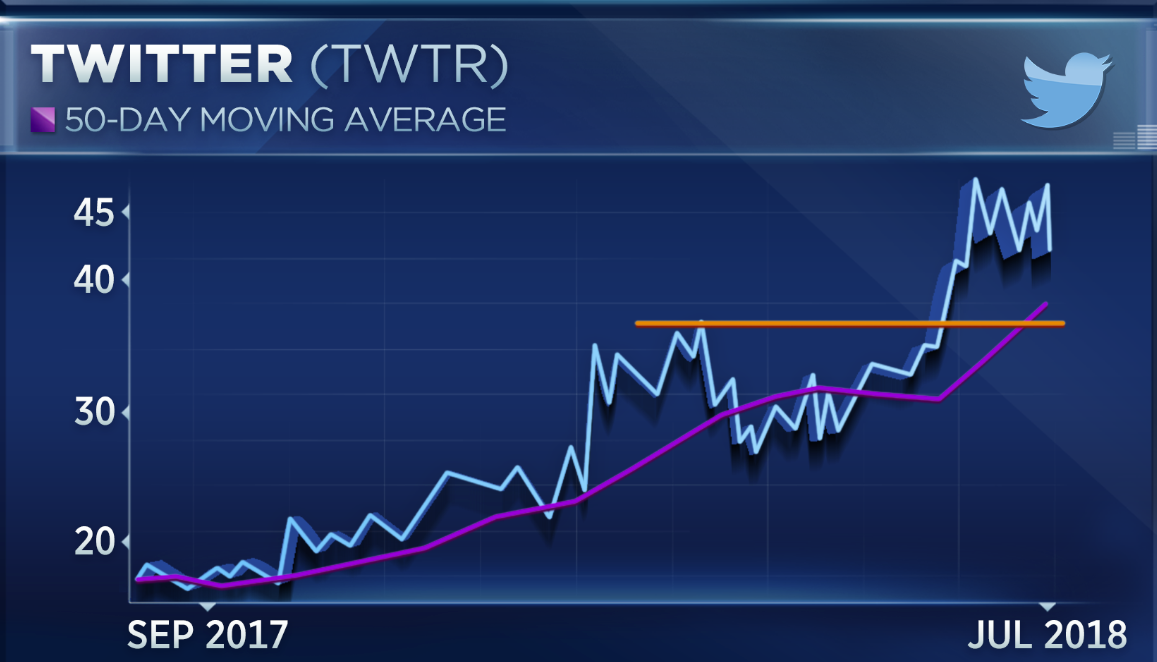
Twitter��s recent dive could mark the perfect opportunity to buy, chart watcher says

Twitter just had its worst day in more than three months on worries over rampant fake accounts.

To investors worried the sky is falling, one chart watcher says these kinds of moves are nothing to sweat.

��This is obviously a substantial decline. ... Obviously alarming but at the same time not that rare,�� Frank Cappelleri, senior equity trader at Instinet, told CNBC��s ��Trading Nation�� on Monday.

Twitter shares moved lower by as much as 12 percent as recently as late March when the tech industry was still in the grips of a sell-off over data privacy. Since going public in November 2013, Twitter shares have fallen by more than 8 percent 19 times.

Twitter had dropped by nearly 10 percent at its session lows on Monday on reports it had suspended as many as 70 million fake accounts in May and June. It pared those losses on assurances from its chief financial officer and ended the session close to 6 percent lower. Its drop takes it back to levels seen in mid-June, a period that marked a new 52-week high.

Monday's pullback could be an opportunity to dive in, Cappelleri says.

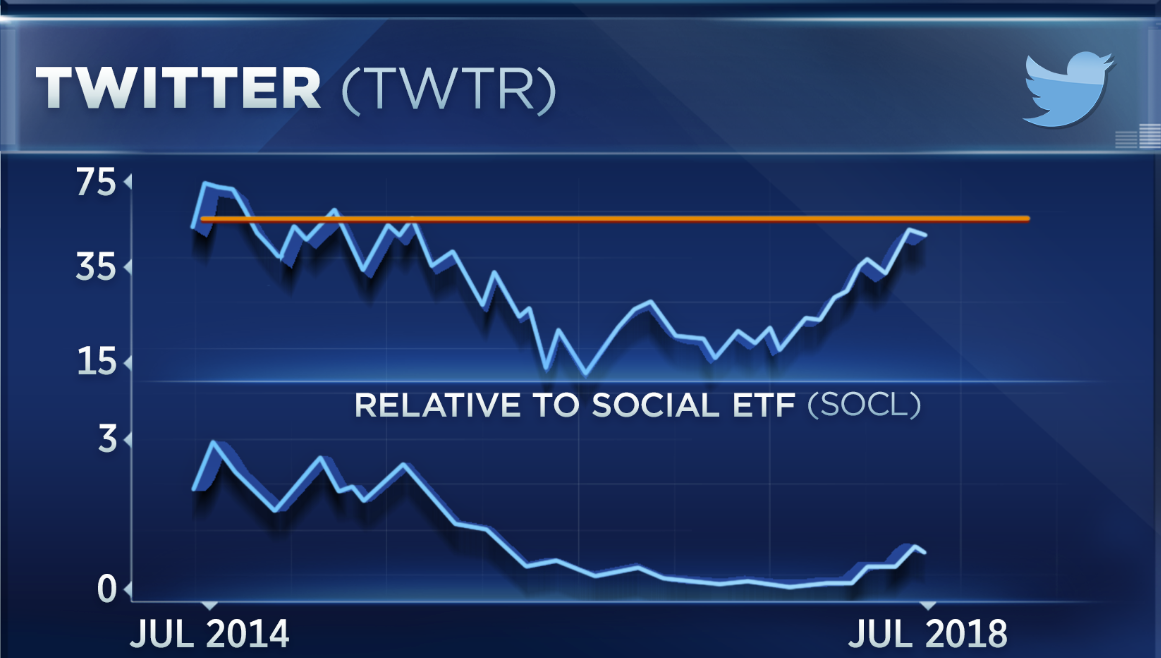
��I don��t know if we have to rally immediately but any time we see Twitter maybe pause near current levels and its breakout point [in June] you can come higher,�� he added. ��The SOCL, this social media ETF, Twitter is actually the biggest component of it and it��s just starting to outperform which I still think could be the beginning stages of doing so."

Twitter is up 83 percent for the year, while the SOCL social media ETF has added 11 percent.

Michael Bapis, managing director of The Bapis Group at Hightower Advisors, sees little of Monday��s sell-off affecting the company��s long-term prospects.

��We look at it as a light breather,�� Bapis said on Monday��s ��Trading Nation.�� ��We think going forward you still use the verb ��tweet�� and until somebody changes that we��re cautiously optimistic on the company.��

Twitter remains the best performer in the technology sector year to date. It has surged 145 percent over the past 12 months.

Vote Vote to see results Total Votes:

Not a Scientific Survey. Results may not total 100% due to rounding.

Disclaimer

Tuesday, July 10, 2018

Why You Should Never Get a Credit Card Advance

You need cash in a hurry, but you don't have the money in your bank account to cover it. Then you remember that your credit card allows you to take cash advances for a small fee. You breathe a sigh of relief and head over to the nearest ATM, not realizing that you're creating an even bigger problem for yourself.

A credit card cash advances is one of the most expensive ways to get extra money in a pinch. Not only can it cost you potentially hundreds of dollars in interest, but it can also lead to a vicious cycle of credit card debt that dings your credit score with each late or partial payment.

Here's a closer look at why you should stay away from credit card advances, as well as some better ways to get that extra cash.

Coins and dollar bills sitting in the middle of a bear trap

Image source: Getty Images.

The problem with cash advances

When you make a purchase with your credit card, you typically have a month to pay it off before it begins accruing interest. This isn't the case with cash advances. They begin accruing interest from day one, and the rates are often much higher than what you'd be charged for a credit card purchase. Purchase APRs usually fall somewhere between 10% and 20%, but it's not uncommon for cash advance APRs to be as high as 25%.

Then there are the cash advance fees to consider. Most companies charge between 2% and 5% of the cash advance amount, and some may have a minimum payment of $5 or $10 as well. This means you could end up paying an even higher percentage in fees if you're only borrowing a small amount. For example, 5% of $50 is $2.50, but if your card has a $10 minimum, you're now paying a 20% cash advance fee.

To put this all in perspective, consider a $1,000 cash advance. Let's assume there's a 25% APR and a 3% cash advance fee. So you'll immediately be charged an extra $30 for the privilege of receiving a cash advance. Then you'll begin accruing interest on that $1,000. If it takes you a year to pay it back, that means you'll end up paying an extra $250, which comes out to about $0.68 in interest per day. So in the end, that "convenient" cash advance cost you an extra $280.

Oh, and if you were hoping you'd at least get some credit card rewards for the cash advance, think again. You won't earn any rewards points, and if you fall behind on your payments, your card issuer will report this to the credit bureaus, which can lower your credit score.

Cash advance alternatives

If you need money in a hurry, there are better ways to get it than a cash advance. Here are a few suggestions.

If you only need a small amount, see if a family member or friend will lend it to you. Often, they won't charge you any interest at all, so this is a much more cost-effective solution than a cash advance. You should only do this if you're sure you can pay the loan back, though. It's a good idea to draw up the loan agreement in writing so that both of you can refer back to it if need be.

Another option is to see if your employer allows salary advances. Not all employers do, but this is one of your best bets for quick cash if it's available to you. Salary advances are your own money, so there are no lenders involved and no interest to pay back. But you should remember that your next paycheck will be smaller than usual.

You can also consider opting for a more traditional loan from a bank. If your credit is good, you'll probably find the rates to be more affordable than a credit card cash advance, and they could be as low as 5%. If you don't qualify for a personal loan from a bank, look into peer-to-peer lending instead. The credit requirements are usually less stringent, so it's easier to get approved. However, the interest rates are higher and can reach up to 30%, so this option may not end up being much more affordable than a cash advance.

Borrowing from your 401(k) or Roth IRA is also a possibility, though you should only do this as a last resort. For one, when you take money out of your retirement accounts, you're losing out on the opportunity to earn interest on that money. For another, you could end up paying more in taxes and fees. You must pay back any money taken from your IRA within 60 days or pay a 10% early-withdrawal penalty if you're under age 59 1/2. You have five years to pay back a 401(k) loan, but you'll also have to pay a low interest rate (typically around 4% or 5%). The good news is that the interest goes toward your retirement savings, not a creditor's pocket.

When you do the math, it's clear credit card cash advances just aren't a smart move. If you find yourself in a pinch, be sure to evaluate all of your options. Chances are, you'll find a more affordable solution that doesn't put you at risk of taking on expensive, high-interest debt.

Monday, July 9, 2018

Smart speaker maker Sonos files to go public

Speaker company Sonos has filed to go public.

The company plans to list shares on the Nasdaq under the ticker symbol "SONO," according to filings. It didn't specify how many shares would be up for sale or list an estimated offering price.

Sonos reported a net loss of $14.2 million on revenue of $992.5 million for the last fiscal year. That's an improvement from fiscal year 2016, when the company posted a net loss of $38.2 million on revenue of $901.3 million.

In fiscal year 2017, more than half of the company's revenue was generated outside the U.S.

For the six months ending March 31, Sonos reported revenue of $655.7 million, an 18 percent jump from the same period in 2017. Net income for the period totaled $13.1 million, a decrease of 14 percent from the year-ago period.

Sonos markets its high-end speakers to audiophiles and music-nuts as the speaker industry increasingly moves toward smart assistants like Amazon's and Google's offerings. Sonos introduced its first voice-enabled speaker, the Sonos One, late last year. It counts traditional speaker makers Bose and Samsung among its competitors, as well.

The company estimates its consumers listen to an average of 70 hours of content per month, according to the filing. As of March 31, Sonos counted more than 19 million registered products in nearly 7 million households globally.

Private equity firm KKR owns about 26 percent of the company, according to the filing. Index Ventures and co-founder and former CEO John McFarlane each own 13 percent.

Morgan Stanley, Goldman Sachs and Allen & Company are the lead underwriters for the offering.

More: Amazon Echo or Google Home? For U.S. households, that's changing

More: We asked Google Assistant, Amazon 's Alexa and Apple's Siri 150 questions. Here's who won.

More: Sonos plus Alexa makes for a smart �� and great-sounding �� speaker

Saturday, July 7, 2018

Insider Buying: GMS (GMS) Director Buys 2,000 Shares of Stock

GMS (NYSE:GMS) Director J David Smith purchased 2,000 shares of the stock in a transaction dated Monday, July 2nd. The shares were acquired at an average cost of $26.66 per share, for a total transaction of $53,320.00. Following the completion of the acquisition, the director now owns 4,000 shares of the company’s stock, valued at $106,640. The transaction was disclosed in a document filed with the SEC, which is available through the SEC website.

GMS traded down $0.13, reaching $26.00, during mid-day trading on Thursday, MarketBeat Ratings reports. 333,600 shares of the stock traded hands, compared to its average volume of 402,960. The stock has a market cap of $1.07 billion, a PE ratio of 13.00, a price-to-earnings-growth ratio of 1.12 and a beta of 1.53. The company has a debt-to-equity ratio of 1.00, a quick ratio of 1.69 and a current ratio of 2.71. GMS has a 12-month low of $23.50 and a 12-month high of $39.98.

Get GMS alerts:

GMS (NYSE:GMS) last posted its quarterly earnings data on Thursday, June 28th. The company reported $0.56 EPS for the quarter, missing analysts’ consensus estimates of $0.66 by ($0.10). The firm had revenue of $635.80 million for the quarter, compared to analysts’ expectations of $674.08 million. GMS had a net margin of 2.51% and a return on equity of 13.00%. The firm’s revenue was up 3.4% compared to the same quarter last year. During the same quarter last year, the company posted $0.48 EPS. sell-side analysts predict that GMS will post 3.34 EPS for the current fiscal year.

A number of research analysts have recently issued reports on GMS shares. TheStreet downgraded GMS from a “b-” rating to a “c” rating in a report on Thursday, June 28th. Zacks Investment Research downgraded GMS from a “buy” rating to a “hold” rating in a report on Tuesday, May 15th. ValuEngine downgraded GMS from a “hold” rating to a “sell” rating in a report on Thursday, June 28th. Seaport Global Securities raised GMS from a “neutral” rating to a “buy” rating and set a $40.00 price target on the stock in a report on Wednesday, March 7th. They noted that the move was a valuation call. Finally, Royal Bank of Canada set a $38.00 price target on GMS and gave the company a “buy” rating in a report on Wednesday, March 7th. One equities research analyst has rated the stock with a sell rating, two have given a hold rating, seven have assigned a buy rating and two have issued a strong buy rating to the company’s stock. The stock presently has an average rating of “Buy” and a consensus target price of $36.18.

Institutional investors have recently bought and sold shares of the stock. Thrivent Financial For Lutherans purchased a new stake in GMS during the fourth quarter valued at $1,685,000. Swiss National Bank increased its position in GMS by 29.7% during the fourth quarter. Swiss National Bank now owns 61,100 shares of the company’s stock valued at $2,300,000 after acquiring an additional 14,000 shares during the last quarter. Wells Fargo & Company MN increased its position in GMS by 12.0% during the fourth quarter. Wells Fargo & Company MN now owns 42,885 shares of the company’s stock valued at $1,614,000 after acquiring an additional 4,599 shares during the last quarter. Teachers Advisors LLC increased its position in GMS by 5.5% during the fourth quarter. Teachers Advisors LLC now owns 520,034 shares of the company’s stock valued at $19,574,000 after acquiring an additional 27,280 shares during the last quarter. Finally, BlackRock Inc. increased its position in GMS by 1.1% during the fourth quarter. BlackRock Inc. now owns 1,688,986 shares of the company’s stock valued at $63,572,000 after acquiring an additional 17,668 shares during the last quarter. Institutional investors own 74.04% of the company’s stock.

About GMS

GMS Inc distributes wallboards, suspended ceilings systems, and complementary interior construction products in North America. The company offers wallboard products; and ceilings products, such as suspended mineral fibers, soft fibers, and metal ceiling systems primarily used in offices, hotels, hospitals, retail facilities, schools, and other commercial and institutional buildings.

Insider Buying and Selling by Quarter for GMS (NYSE:GMS)

Friday, July 6, 2018

Pembina Pipeline (PBA) Cut to “Sell” at ValuEngine

ValuEngine cut shares of Pembina Pipeline (NYSE:PBA) (TSE:PPL) from a hold rating to a sell rating in a research note released on Monday.

Separately, Zacks Investment Research lowered Pembina Pipeline from a strong-buy rating to a hold rating in a research note on Wednesday, May 2nd. Two research analysts have rated the stock with a sell rating, two have given a hold rating and one has issued a buy rating to the company’s stock. The company presently has a consensus rating of Hold and an average target price of $37.00.

Get Pembina Pipeline alerts:

Shares of Pembina Pipeline opened at $34.68 on Monday, MarketBeat Ratings reports. The firm has a market cap of $17.47 billion, a P/E ratio of 26.08 and a beta of 0.66. Pembina Pipeline has a 12 month low of $29.28 and a 12 month high of $36.99. The company has a debt-to-equity ratio of 0.65, a quick ratio of 0.83 and a current ratio of 0.95.

Pembina Pipeline (NYSE:PBA) (TSE:PPL) last issued its earnings results on Thursday, May 3rd. The pipeline company reported $0.59 earnings per share (EPS) for the quarter, beating the Thomson Reuters’ consensus estimate of $0.45 by $0.14. The firm had revenue of $1.84 billion for the quarter, compared to analyst estimates of $1.92 billion. Pembina Pipeline had a return on equity of 10.07% and a net margin of 17.53%. The business’s revenue was up 24.1% on a year-over-year basis. During the same period in the previous year, the company posted $0.49 earnings per share. research analysts anticipate that Pembina Pipeline will post 1.95 EPS for the current year.

The company also recently announced a jun 18 dividend, which will be paid on Sunday, July 15th. Shareholders of record on Monday, June 25th will be paid a $0.19 dividend. The ex-dividend date is Friday, June 22nd. This represents a dividend yield of 5.08%. Pembina Pipeline’s payout ratio is presently 132.33%.

Institutional investors and hedge funds have recently modified their holdings of the business. SWS Partners bought a new stake in shares of Pembina Pipeline in the fourth quarter valued at $100,000. Icon Wealth Partners LLC bought a new stake in shares of Pembina Pipeline in the fourth quarter valued at $103,000. Cubist Systematic Strategies LLC raised its stake in shares of Pembina Pipeline by 73.9% in the first quarter. Cubist Systematic Strategies LLC now owns 6,085 shares of the pipeline company’s stock valued at $190,000 after buying an additional 2,585 shares during the period. BB&T Securities LLC bought a new stake in shares of Pembina Pipeline in the fourth quarter valued at $200,000. Finally, Marco Investment Management LLC bought a new stake in shares of Pembina Pipeline in the fourth quarter valued at $202,000. Hedge funds and other institutional investors own 45.54% of the company’s stock.

About Pembina Pipeline

Pembina Pipeline Corporation provides transportation and midstream services for the energy industry in North America. It operates through three divisions: Pipelines, Facilities, and Marketing & New Ventures. The company operates approximately 10,000 kilometers of pipeline network that transports hydrocarbon liquids and extends across Alberta and parts of British Columbia, Saskatchewan, and North Dakota; and owns and operates the Nipisi and Mitsue pipelines, which provide transportation for producers operating in the Pelican Lake and Peace River heavy oil regions of Alberta; transports synthetic crude oil for the Syncrude project and the Horizon project to delivery points near Edmonton, Alberta; and operates Cheecham Lateral, which transports synthetic crude to oil sands producers operating southeast of Fort McMurray, Alberta.

To view ValuEngine’s full report, visit ValuEngine’s official website.

Thursday, July 5, 2018

DigitalPrice (DP) Market Capitalization Tops $1.04 Million

DigitalPrice (CURRENCY:DP) traded down 0% against the US dollar during the 1-day period ending at 20:00 PM E.T. on July 4th. During the last seven days, DigitalPrice has traded 12.7% lower against the US dollar. One DigitalPrice coin can now be purchased for $0.0523 or 0.00000796 BTC on major exchanges including CoinExchange and Cryptopia. DigitalPrice has a market capitalization of $1.04 million and $1,534.00 worth of DigitalPrice was traded on exchanges in the last day.

Here is how other cryptocurrencies have performed during the last day:

Get DigitalPrice alerts: Aston (ATX) traded 0.8% lower against the dollar and now trades at $0.0491 or 0.00000746 BTC. Pura (PURA) traded 3.8% higher against the dollar and now trades at $0.0947 or 0.00001439 BTC. Polis (POLIS) traded 1% lower against the dollar and now trades at $1.14 or 0.00017389 BTC. ArcticCoin (ARC) traded down 12.8% against the dollar and now trades at $0.0422 or 0.00000513 BTC. Adzcoin (ADZ) traded 0.4% lower against the dollar and now trades at $0.0181 or 0.00000276 BTC. Advanced Technology Coin (ARC) traded down 6.3% against the dollar and now trades at $0.0232 or 0.00000353 BTC. Onix (ONX) traded 0.5% lower against the dollar and now trades at $0.0049 or 0.00000074 BTC. Startcoin (START) traded up 1.7% against the dollar and now trades at $0.0088 or 0.00000134 BTC. Prime-XI (PXI) traded up 1.7% against the dollar and now trades at $0.0045 or 0.00000069 BTC. Uro (URO) traded flat against the dollar and now trades at $0.0411 or 0.00000536 BTC.

DigitalPrice Profile

DigitalPrice is a proof-of-work (PoW) coin that uses the X11 hashing algorithm. Its launch date was April 21st, 2016. DigitalPrice’s total supply is 27,280,675 coins and its circulating supply is 19,780,674 coins. DigitalPrice’s official Twitter account is @DigitalPriceOrg and its Facebook page is accessible here. DigitalPrice’s official website is digitalprice.org. The Reddit community for DigitalPrice is /r/DigitalPriceOrg and the currency’s Github account can be viewed here.

DigitalPrice Coin Trading

DigitalPrice can be purchased on these cryptocurrency exchanges: CoinExchange and Cryptopia. It is usually not currently possible to buy alternative cryptocurrencies such as DigitalPrice directly using U.S. dollars. Investors seeking to acquire DigitalPrice should first buy Ethereum or Bitcoin using an exchange that deals in U.S. dollars such as Coinbase, GDAX or Changelly. Investors can then use their newly-acquired Ethereum or Bitcoin to buy DigitalPrice using one of the exchanges listed above.